For 34 years, Albert Spaggiari was known as the mastermind behind France’s most audacious bank robbery. In 1976, thieves tunneled into a Nice bank vault and escaped with around 50 million francs, but the mystery did not end there. Decades later, a man known only as “Amigo” claimed Spaggiari had taken credit for a plan he never created. His accusation reopened a question that still has no definitive answer: who really masterminded the heist?
The Robbery Began Underground
The target was the main Société Générale branch in Nice. Rather than breaking through the bank itself, the thieves approached from below, digging a tunnel roughly eight meters long through the sewer system toward the vault. According to later accounts, the tunnel was dug by hand because powered tools would have created too much noise, turning the operation into a slow and physically demanding piece of work.
The timing helped them enormously. The gang entered the vault during the Bastille Day holiday period in July 1976 and remained inside for the weekend, opening hundreds of deposit boxes before leaving. Contemporary accounts put the haul at around 50 million French francs, a fortune at the time, consisting of cash and valuables. When employees eventually discovered what had happened, the thieves were already gone.
They also left behind a bizarre final touch. On a wall, the gang wrote a message that became inseparable from the crime: “Without hatred, without violence and without weapons.” The line helped transform an extraordinary burglary into something closer to French criminal folklore, especially because there had been no conventional shootout or hostage situation.
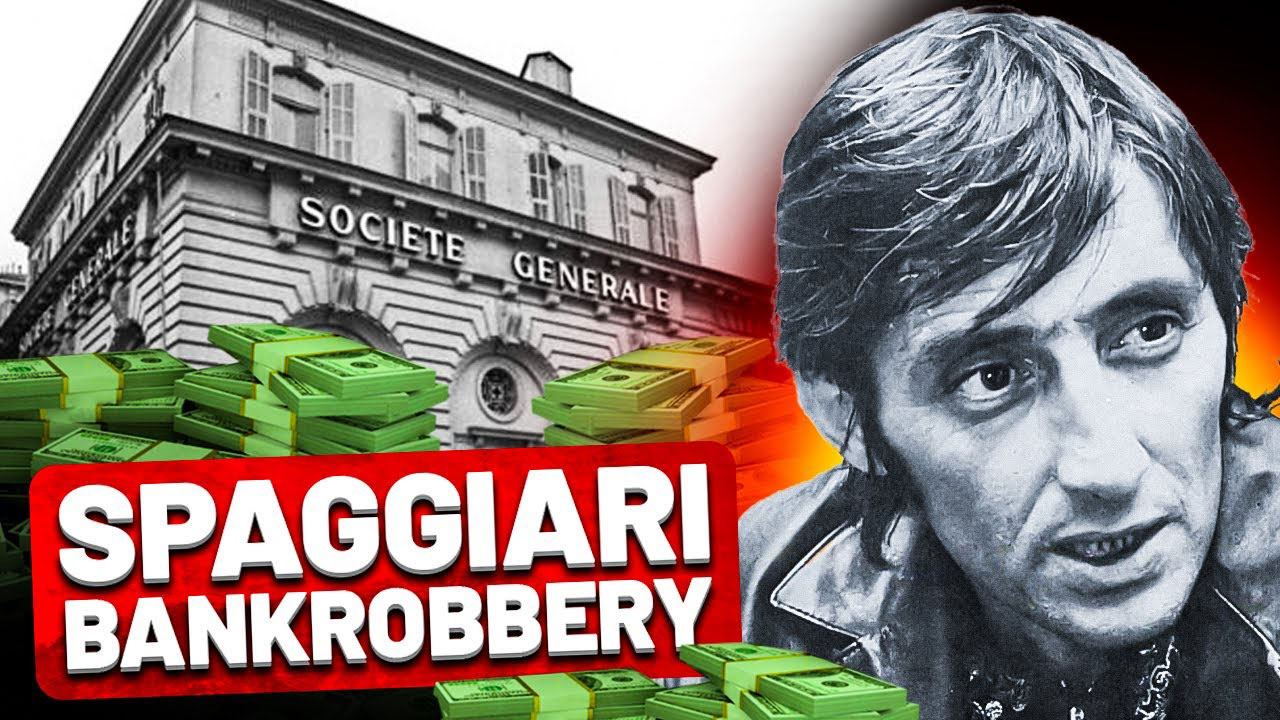
Ever wonder how $40 million vanished without a single shot fired? Discover the incredible true story of Albert Spaggiari and the 1976 Société Générale heist. From secret sewer tunnels to an audacious prison escape, dive into one of history’s most brilliant bank robberies. Watch the full story now!
Then Spaggiari Became the Face of the Heist
Albert Spaggiari soon emerged as the man most closely associated with the robbery. A photographer from Nice and a former paratrooper, he was arrested several months after the break-in and became the central figure in the investigation and subsequent trial. He presented himself as the mastermind, and his own version of events helped create the larger-than-life reputation that followed him for the rest of his life.
Then came the escape that made him famous far beyond France. In 1977, while appearing at the Nice courthouse, Spaggiari jumped from a window and escaped, reaching a motorcycle and disappearing before authorities could stop him. He was never captured again, and the escape became one of the defining chapters of his legend.
From that point on, Spaggiari was no longer simply a suspect in a famous robbery. He became the story itself. He spent the rest of his life in hiding, gave occasional television interviews and published a memoir before his death in 1989, all of which helped keep his version of the Nice heist alive.

Then a Man Called “Amigo” Challenged the Entire Story
For decades, that was the accepted mythology: Spaggiari had been the brilliant criminal mastermind who organized the robbery and then escaped justice. But in 2010, a man using the name “Amigo” came forward and said the story was fundamentally wrong. He claimed Spaggiari had supplied useful information about the bank but had not planned the operation and had not even understood important details about the vault or the escape.
Amigo’s version was much more specific than a simple denial. He claimed Spaggiari did not help dig the tunnel and said the underground work had been carried out by a group of men whom he identified in his book, The Truth About the Nice Heist. He also claimed that the famous message left on the wall was his idea and had nothing to do with the political meaning later attached to Spaggiari’s version of the crime.
His claim created an obvious problem for the legend. If Amigo was telling the truth, the man remembered as the mastermind may have been little more than an informant who later built himself into the most famous character in the story. Amigo even questioned how an obscure photographer could have become the head of such a large and technically demanding operation without exaggerating his role.
But Nobody Could Completely Prove Amigo Was Right
There was never a clean resolution to the dispute. Amigo refused to reveal his real name and said he had served time in prison for other matters, but had never been arrested for the Nice robbery itself. His publishers said they had investigated his background and that a police source had identified him as one of the suspected perpetrators, yet there had been too little evidence to charge him with the crime.
That distinction is crucial. Amigo may have possessed inside knowledge, but his testimony was still a personal account from a man whose identity remained concealed. The story therefore cannot honestly be rewritten as a proven revelation that Spaggiari was a fraud; what it established was something more intriguing—a serious competing version of one of France’s most famous crimes.
Even the celebrated escape was challenged. The familiar story suggested that Spaggiari’s getaway had been carefully prepared, but Amigo said the motorcycle waiting below the courthouse was there largely by chance, with a friend simply happening to be nearby. The escape itself is part of the historical record; how much of the surrounding legend was later embellished is much harder to determine.
Dive into the gripping true story of Albert Spaggiari, the wedding photographer who orchestrated Europe’s most audacious bank heist. Discover his meticulous plan to tunnel into the Société Générale vault in Nice, the chaotic aftermath, and his legendary escape. Don’t miss this thrilling account of a mastermind’s rise and fall—watch now!
The Man Who Became a Legend
Spaggiari understood the power of a good story. After disappearing, he continued to feed public fascination with interviews, photographs and his memoir, while stories about political connections and even CIA involvement grew around the robbery. The Independent noted that his reputation expanded into a mixture of folklore, books, films and theories that made separating documented events from later mythology increasingly difficult.
That may be why Amigo’s claim was so disruptive. He was not simply saying that one detail had been misunderstood; he was challenging the identity of the person who deserved the central role in the entire story. According to his account, Spaggiari’s greatest talent was not tunnel-building or planning the robbery, but creating a personality large enough to make everyone believe he had done it.
There is no definitive evidence that settles the argument in Amigo’s favor. But there is also no longer a simple reason to assume that the legend surrounding Spaggiari tells us everything about how the robbery was actually organized.

What We Know—and What Remains a Mystery
The hard facts are extraordinary enough without embellishment. In July 1976, a gang reached the vault of Société Générale in Nice through an underground route, spent the holiday weekend inside and escaped with around 50 million francs. Spaggiari was later arrested, escaped from custody in 1977 and remained at large until his death in 1989.
What remains harder to pin down is the question that has kept the story alive: who really masterminded the robbery? Spaggiari claimed the role and built a legend around it, while Amigo later claimed that he and the tunnelers were the real architects and that Spaggiari received far more credit than he deserved. Because Amigo was never charged and his account could not be fully verified, the mystery remains exactly that—a mystery.
And perhaps that is what makes the Nice heist more fascinating than a conventional crime story. The tunnel was real, the money was real and the escape was real, but the legend grew so large that even the identity of the mastermind became part of the puzzle. More than three decades after Spaggiari’s disappearance, another man stepped forward to say that the most famous name in the story might never have been the man who truly built it.

The Nice bank robbery has remained famous for nearly half a century because it combined an extraordinary plan with an equally extraordinary escape. But the final mystery is not how the thieves reached the vault—it is whether the man who became the face of the crime was really its mastermind. Spaggiari spent years shaping that legend, while “Amigo” later offered a very different version and claimed the credit belonged elsewhere. No definitive evidence settled the dispute, leaving France’s most famous heist with one question still hanging over it: who was really behind the plan?
This story draws on the original reporting about France’s extraordinary Nice bank heist, including the underground tunnel, the stolen fortune and the decades-long mystery over who truly planned it.
Sources: https://www.independent.co.uk/news/world/europe/who-really-masterminded-france-s-crime-of-the-century-2058069.html