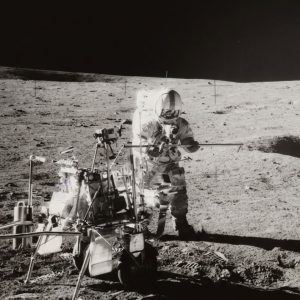
America did not reach space with a single rocket, a single astronaut or a single historic launch. It took decades of engineering, enormous machines, dangerous experiments and a willingness to spend billions pursuing destinations no human had ever reached. From the small spacecraft that carried the first Americans beyond Earth to launch vehicles powerful enough to send missions toward the Moon, these images capture a story of technological ambition on a scale almost difficult to comprehend.
Delta IV Heavy: A Tower of Fire
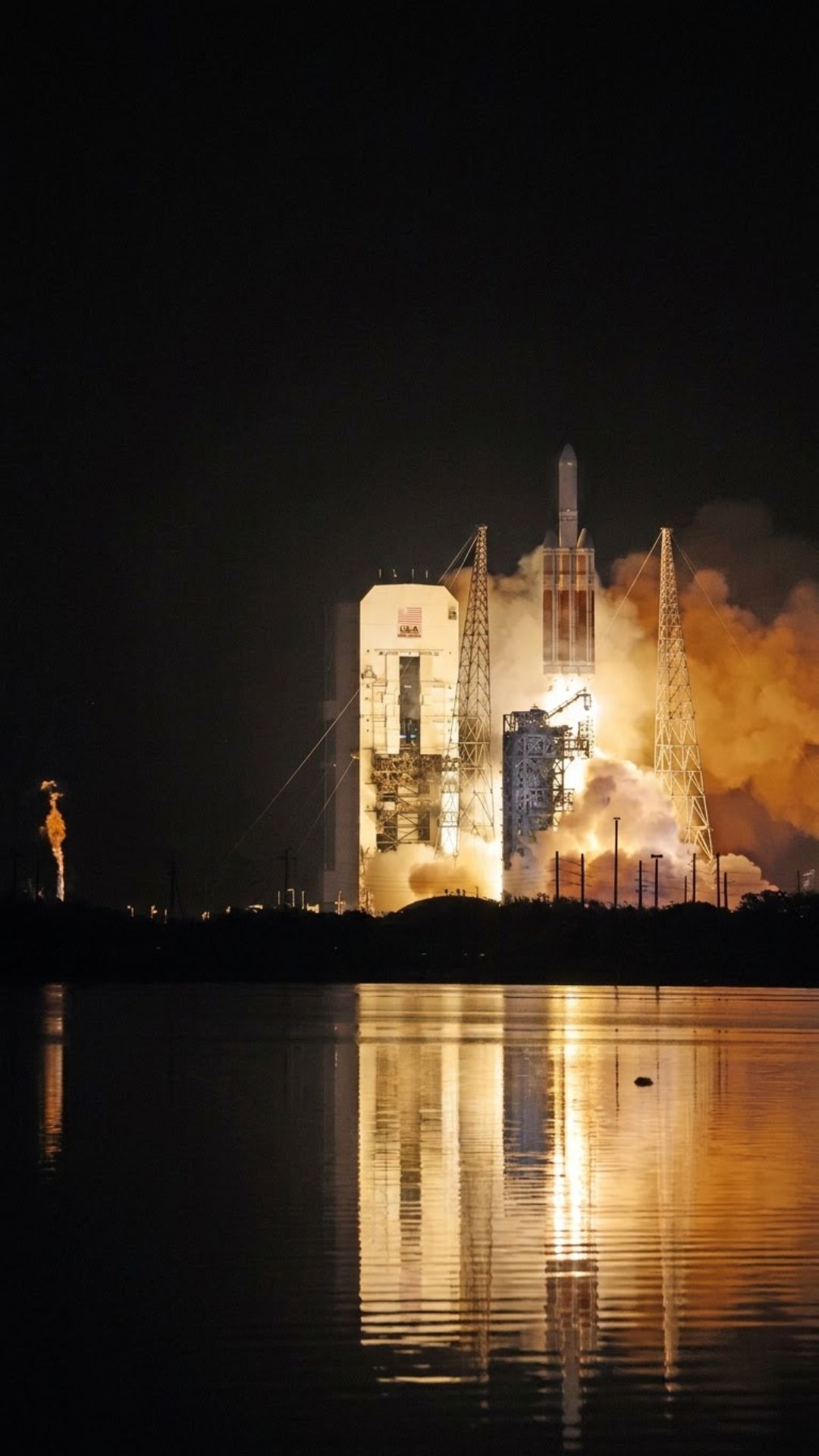
Few machines demonstrate the sheer violence of rocket propulsion like the Delta IV Heavy. Standing roughly 235 feet tall, the launch vehicle represented one of America’s most powerful operational rockets before its retirement.
At liftoff, three Common Booster Cores produced an extraordinary amount of thrust, surrounding the rocket with fire, steam and noise as it climbed away from Earth. From a distance, a rocket launch can look almost elegant. Up close, it is a controlled explosion powerful enough to push hundreds of thousands of pounds of machinery toward orbital speed.
The Delta IV Heavy was built for missions that demanded serious lifting capability. Its size was a reminder that spaceflight still begins with one brutally simple challenge: escaping Earth’s gravity.

Falcon 9: The New Face of American Spaceflight
The Falcon 9 changed how Americans think about rockets.
For decades, launch vehicles were essentially disposable. Engineers built them, launched them once and watched their most expensive components fall into the ocean or burn up in the atmosphere.
SpaceX helped challenge that model by developing rockets capable of returning to Earth for reuse. Images of Falcon 9 launches passing above familiar landscapes—including Florida’s coast and landmarks such as the Ponce Inlet Lighthouse—show how spaceflight has moved from a purely government-controlled activity into a new era of private industry.
The rocket is not merely a machine. It represents a change in philosophy: if humanity wants to launch more often, rockets cannot always be treated as disposable.

From Mercury and Apollo to the Space Shuttle and Artemis, these giant machines helped take America beyond Earth. Watch the video to explore 15 incredible moments from the nation’s journey into space.
Gemini and the Space Shuttle: Two Eras Side by Side
Some of the most revealing images in space history show how dramatically spacecraft changed over time.
The Gemini capsule of the 1960s was compact, cramped and built for missions that pushed astronauts toward the techniques required for a journey to the Moon. Nearby, the Space Shuttle represented a completely different vision: a large reusable spacecraft capable of carrying crews, satellites and scientific equipment.
The contrast between them reveals how quickly American spaceflight evolved.
Gemini helped prove that astronauts could survive and work in space for extended periods. The Space Shuttle later made orbital operations appear almost routine. Between them stood decades of engineering progress—and countless lessons learned from failure.

Antares and Cygnus: The Supply Line to Space
Exploration is impossible without logistics.
The International Space Station may orbit hundreds of miles above Earth, but astronauts still need food, experiments, replacement equipment and supplies. That makes cargo missions essential.
The Antares rocket was developed to launch Cygnus cargo spacecraft toward the ISS, carrying thousands of pounds of equipment into orbit. These missions may not receive the same attention as a Moon landing, but they represent another important reality of space exploration.
Once humans leave Earth, someone still has to run the supply chain.
The image of a rocket lifting a cargo spacecraft toward orbit is therefore part of a larger story: space is no longer only about heroic individual missions. It increasingly depends on transportation networks and repeated access to orbit.

The Men Waiting in the Ocean
Not every space story begins with a launch.
One of the less glamorous but essential parts of early American spaceflight involved recovery teams preparing to rescue astronauts after splashdown. Military personnel trained to reach spacecraft and crews returning from missions in the ocean.
This connection between the military and America’s early space program was significant. Spaceflight required expertise in aviation, survival, navigation, communications and recovery—areas where military institutions already possessed enormous experience.
An astronaut might become famous for traveling into space, but getting him home safely required a much larger operation.

Alan Shepard’s Suit and the Beginning of an Era
Before Americans walked on the Moon, one American had to prove that the country could send a human into space at all.
Alan Shepard became the first American in space in 1961 during the Mercury-Redstone 3 mission. His flight lasted only minutes compared with modern missions, but its historical significance was enormous.
The pressure suit associated with Shepard’s journey now represents an era when astronauts entered spacecraft with very little certainty about what would happen next.
The technology was primitive by modern standards. Computers had a fraction of the power of a smartphone. Yet the United States was beginning a journey that would eventually lead to the Moon.
Every giant machine that came later began with missions like this one.

A Rocket Seen From Nearly 400 Miles Away
The scale of a rocket launch can be difficult to understand until it is seen from extreme distances.
A powerful launch can create a visible trail stretching across the sky, with sunlight illuminating exhaust and vapor long after the rocket has disappeared from normal view.
Images captured hundreds of miles away demonstrate something remarkable: a machine leaving Earth can temporarily alter the appearance of the sky itself.
This is one reason rocket launches remain visually powerful even in an age when launches have become more frequent. A vehicle only a few hundred feet tall can produce a phenomenon visible across an entire region.

Discovery: The Machine That Made Spaceflight Look Routine
For many Americans, the Space Shuttle Discovery represents the era when human spaceflight became part of modern life.
The Shuttle program was extraordinary because it attempted something fundamentally different from the capsules that came before it. The orbiter could launch vertically, operate in space and return to Earth for a runway landing.
Discovery became one of NASA’s most accomplished orbiters, completing dozens of missions during its career.
Seeing the spacecraft preserved in a museum today creates an unusual feeling. What once represented cutting-edge engineering is now an artifact.
But it remains a reminder of an era when Americans watched launches and landings as part of the regular rhythm of national life.

The Vehicle Assembly Building: Where Rockets Become Giants
Before the rocket reaches the launchpad, it must be assembled somewhere.
At NASA’s Kennedy Space Center, the Vehicle Assembly Building is one of the most recognizable structures in American engineering. Its immense interior was designed to accommodate some of the largest launch vehicles ever constructed.
The building itself is almost a monument to scale.
Inside, engineers assembled the Saturn V rockets that carried Apollo astronauts toward the Moon. Decades later, the same facility became part of preparations for new generations of missions.
The Vehicle Assembly Building demonstrates an often-overlooked fact about space exploration: the rockets may be spectacular, but the infrastructure required to build and launch them can be just as astonishing.

The International Space Station Crossing the Moon
Some space photographs create a strange sense of perspective.
The International Space Station is an enormous structure by spacecraft standards, yet against the Moon it can appear as a tiny silhouette moving across a much larger celestial body.
The image connects different eras of human ambition.
The Moon represents the destination that defined the Apollo generation. The ISS represents a different achievement: maintaining a permanent human presence in low Earth orbit through international cooperation.
America’s space story did not end when Apollo astronauts left the Moon.
It evolved into a long-term effort to keep humans working above Earth.

Training Underwater for the Vacuum of Space
How do you prepare a human being for a place where there is no gravity?
One answer is water.
NASA has long used underwater environments to simulate certain aspects of spacewalking. Astronauts can practice moving large objects, handling tools and navigating complex structures while floating in a controlled environment.
The training may look peaceful in photographs. In reality, it represents thousands of hours of preparation for missions where even a small mistake can become dangerous.
Space exploration is often associated with courage.
But behind every famous mission is repetition.
Astronauts practice until extraordinary situations become familiar.

Artemis I: America Prepares to Return to the Moon
The Artemis program represents one of the most ambitious new chapters in American spaceflight.
Artemis I was an uncrewed test mission designed to demonstrate the Space Launch System and Orion spacecraft as part of NASA’s broader plan to return humans to lunar space.
The symbolism is impossible to miss.
More than half a century after Apollo, the United States is again building rockets capable of carrying missions toward the Moon.
But the new objective is not simply to repeat the past.
NASA’s long-term Artemis vision includes developing capabilities for sustained lunar exploration and using the Moon as a foundation for deeper missions into space.
The giant machines are back.
Only this time, the journey may be intended to last longer.

Atlas V and the Long Trail Across the Sky
An Atlas V launch can leave an extraordinary pattern across the atmosphere.
As the rocket climbs through different layers of air, its exhaust interacts with sunlight and moisture, creating long trails that sometimes remain visible after the vehicle itself is gone.
These images reveal the hidden beauty of engineering.
A rocket is built from fuel tanks, valves, computers and engines. Yet when it operates correctly, the result can create one of the most dramatic sights in the sky.
For engineers, the launch represents years of calculations and testing.
For everyone watching from the ground, it can look like the beginning of a science-fiction film.

The Shift From Government Rockets to Private Space Companies
For much of the Space Age, America reaching space largely meant one thing: NASA.
That is no longer the full story.
Private companies have become increasingly important in launch services, cargo transportation, satellite deployment and the development of reusable rockets. SpaceX and Blue Origin represent different visions of what commercial spaceflight could become.
This does not mean the government has disappeared.
NASA remains central to major scientific and human exploration programs. But the relationship has changed. Government agencies, private companies and international partners now operate within a much larger space economy.
The machines may still launch from many of the same Florida sites.
The people building them are increasingly different.

From One Astronaut to an Entire Space Economy
The most extraordinary part of America’s space journey may be how far it has moved beyond its original goals.
The first American spaceflights were primarily demonstrations of national capability. Could the United States launch a human into space? Could astronauts survive? Could the country reach the Moon before its Cold War rival?
Today, the questions are much broader.
Can rockets be reused? Can private companies launch frequently enough to transform access to orbit? Can humans establish a sustainable presence around the Moon? Can space infrastructure eventually support missions to Mars?
The machines in these photographs represent different answers to the same challenge.
Build something powerful enough to take humanity somewhere it has never been.

From Alan Shepard’s first flight to Artemis-era rockets, America’s journey into space has always depended on machines built at the limits of what engineers believed possible. These 15 images show more than launches and spacecraft. They capture decades of ambition, risk and technological progress. The rockets have changed, the astronauts have changed and private companies have entered the race—but the original idea remains the same: build something big enough, powerful enough and reliable enough to leave Earth behind.