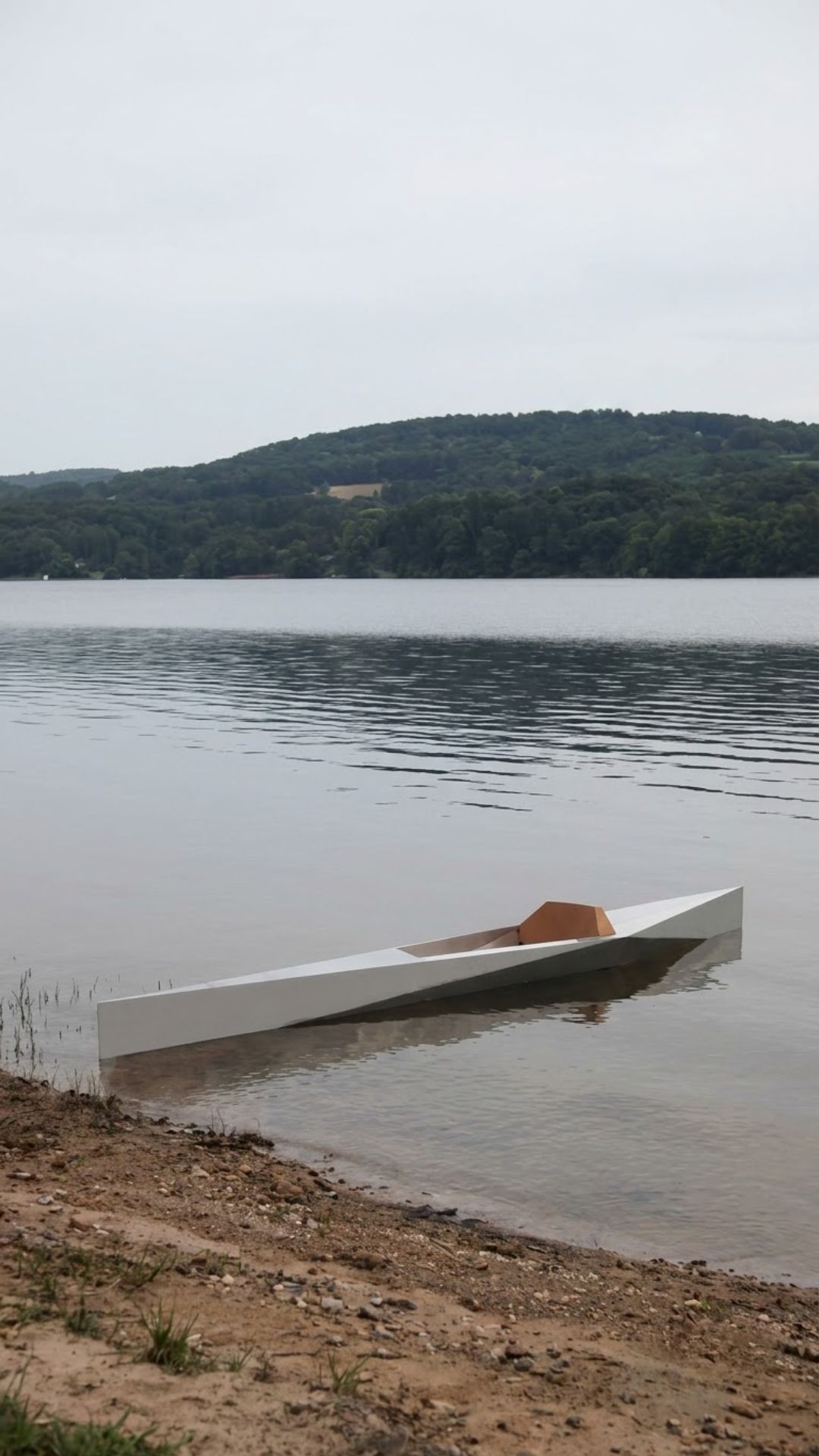
At first glance, the Sharp kayak looks more like a giant sheet of metal folded into a series of sharp geometric angles than a traditional boat. But its unusual appearance is directly connected to the way it works. The folds help strengthen the aluminum hull, while a double-wall structure supports buoyancy without relying on a conventional internal frame. After being tested through multiple scale models, the design became a full-size hand-built kayak that explores an unusual engineering question: how much structure can be created simply by changing the shape of a flat piece of metal?
It Started With a Machine Designed to Bend Metal
The Sharp kayak began with a manufacturing tool rather than a traditional boat design.
French designer Guillaume Bloget developed the project while working in Morvan, France, where a newly acquired press brake became an unexpected source of inspiration. Instead of beginning with the familiar shape of a kayak and then deciding how to build it, Bloget explored what could happen if the capabilities of the machine itself influenced the design.
A press brake is designed to bend sheet metal along precise lines. That simple manufacturing process became the foundation of Sharp.
The idea was straightforward: could a flat sheet of aluminum be cut and folded into a rigid structure capable of becoming a functional kayak?
That question gave the project its distinctive appearance.
The sharp edges were not added simply to make the kayak look futuristic. They were a direct consequence of the manufacturing method. In this case, the process of making the object became part of the process of designing it.
Rather than hiding the marks of production, Sharp makes them the central visual feature of the finished kayak.

From a Flat Aluminum Sheet to a Functional Kayak
Traditional kayaks are commonly built around smooth curves.
Their hulls may be molded from plastic, shaped from composite materials or constructed using other methods designed to create continuous surfaces. Sharp takes a very different approach.
Its structure begins with flat aluminum sheet.
The material is cut and then folded into a series of carefully positioned planes. Once assembled, these planes create the overall shape of the hull.
This approach changes the relationship between material and form.
A conventional manufacturing process might begin with a finished digital model containing complex curves and then require specialized tooling to reproduce that shape. Sharp instead works with the natural strengths and limitations of sheet-metal fabrication.
Flat material prefers to remain flat.
A press brake can create straight folds with precision.
The resulting product therefore uses planes, edges and angles as its basic design language.
The transformation is what makes the project so compelling. A flat industrial material becomes a three-dimensional watercraft without relying on the visual vocabulary normally associated with boats.
It still has to float.
It still has to move efficiently through water.
And it still has to support a person.
But it reaches those goals through geometry that looks closer to folded architecture or industrial engineering than traditional boatbuilding.
Watch the video to see the remarkable kayak that can be folded down into a suitcase-sized form. Its clever engineering makes it easier to transport and store while still allowing it to function as a real watercraft when fully assembled.
Why the Folds Make the Hull Stronger
The folds are not just decorative.
They are a fundamental part of the kayak’s structural system.
A flat sheet of metal can bend relatively easily when force is applied across a large surface. But changing the geometry of that sheet can significantly increase its resistance to deformation.
This principle appears in many areas of engineering.
Corrugated metal sheets use repeated folds to create stiffness. Aircraft structures use carefully shaped surfaces and reinforced sections to achieve strength without excessive weight. Origami-inspired engineering has also explored how folds can transform flexible flat materials into rigid three-dimensional structures.
Sharp applies a similar principle.
Each fold changes the way forces move through the aluminum hull. Instead of behaving like one large flat surface, the material becomes a network of connected planes and edges.
The geometry itself begins to carry structural responsibility.
This is why the kayak’s angular appearance matters.
Its sharp lines are not simply a stylistic choice placed on top of a conventional structure. The lines are part of the structure.
In a sense, the hull does not need to hide its engineering. The engineering is visible from the outside.
That idea can be summarized in a simple phrase: geometry becomes part of the structure.

How a Metal Kayak Can Stay Afloat
The idea of an aluminum kayak may initially seem counterintuitive.
Metal is often associated with objects that sink. Boats are associated with materials that float.
But whether an object floats depends on more than the density of the material from which it is made.
A steel ship can float because its overall structure encloses a large volume of air. The same basic principle allows a metal watercraft to remain afloat. What matters is the relationship between the object’s total mass and the volume of water it displaces.
Sharp uses a double-wall construction that creates enclosed volumes within the structure.
According to the project’s design concept, this construction contributes to buoyancy while also helping provide structural rigidity. The double-wall system therefore performs more than one function at the same time. (designboom.com)
The aluminum hull provides the external structure.
The enclosed spaces contribute to the overall buoyancy of the design.
This does not mean that the material itself magically becomes lighter than water. Instead, the complete structure is engineered as a combination of material, shape and enclosed volume.
The project has been described as using an “unsinkable” hull. That description should be understood as part of the design concept rather than a guarantee that the kayak could never sink under every possible real-world condition. Actual performance would depend on construction integrity, loading and operating conditions.
Still, the principle behind Sharp is clear: a metal hull can float when its geometry and enclosed volume are designed correctly.
The Hull Shape Was Tested Before the Real Kayak Was Built
Sharp was not created simply as a visual experiment.
Before the full-size kayak was produced, the design team built and tested multiple scale models on water.
This stage was important because a boat cannot be judged only by the way it looks.
The hull must interact with water in a predictable and efficient way. A design that appears elegant in a workshop may behave very differently once it is placed on the surface of a lake or river.
Testing smaller models allowed the designers to examine the behavior of different hull shapes before committing to a full-size version.
The process focused on questions such as buoyancy and how efficiently the shape could move through water. According to the project description, the models were tested and refined to reduce energy losses while paddling. (designboom.com)
That development process gives Sharp an important engineering dimension.
The unusual appearance is supported by experimentation.
The final design is therefore not simply the result of deciding that an angular kayak would look interesting. The geometry had to be tested against the practical demands of a working watercraft.
This is where design becomes engineering.
A form can be visually unusual, but if it cannot move through water effectively, the project remains a sculpture rather than a kayak.
Sharp had to prove that its folded surfaces could become part of a functional hull.
Sharp Angles Meet Hydrodynamic Design
One of the biggest challenges behind Sharp is the relationship between manufacturing and hydrodynamics.
Watercraft designers often use smooth curves because curved surfaces can help control how water flows around a hull. Sharp, however, begins with a manufacturing technique that naturally produces straight folds and flat planes.
That creates an engineering trade-off.
The design cannot simply ignore hydrodynamics in favor of easy manufacturing. At the same time, it must work within the limitations and opportunities created by sheet-metal fabrication.
The solution was to develop the hull shape through experimentation.
Instead of reproducing the smooth, organic form of a conventional kayak, Sharp uses a sequence of carefully positioned planes. These surfaces collectively create the volume and profile needed for the boat to operate on water.
The angular design also helps make manufacturing more direct.
Complex curved metal surfaces can require more specialized processes. Straight folds, by contrast, can be produced with a press brake.
The challenge is therefore not to eliminate the angles.
It is to use them intelligently.
Sharp demonstrates that a watercraft does not necessarily need to look traditionally streamlined to be designed with hydrodynamic performance in mind. Different geometries can produce different solutions.
The final form is the result of a negotiation between two requirements: the kayak must be practical to manufacture from aluminum sheet, and it must still perform as a boat.
That tension is one of the most interesting parts of the entire project.

Aluminum Outside, Cork Where the Paddler Sits
Sharp is dominated visually by aluminum, but the most important contact point for the person inside the kayak uses a very different material.
The seat is made from cork.
This creates a striking contrast.
Outside, the kayak looks cold, industrial and sharply engineered. Inside, the paddler encounters a natural material with a softer and warmer character.
The choice also reflects an important principle of good engineering.
A machine may be optimized for structural performance, but the human body still has to interact with it.
The hull must be rigid.
The shape must provide buoyancy.
The manufacturing method must be practical.
But the person operating the kayak needs comfort.
The cork seat therefore acts as the point where the technical object becomes more human-centered.
According to the project’s description, the cork interior was chosen as a contrast to the aluminum body, creating a more natural and comfortable environment for the paddler.
It is a small detail, but it helps explain the broader thinking behind the design.
Sharp is not only an experiment in how metal can be folded.
It is also an experiment in how different materials can perform different roles within the same object.
Aluminum handles structure.
Geometry provides stiffness.
Enclosed volume supports buoyancy.
Cork addresses the human experience.
A Hand-Built Experiment in Engineering and Design
After the first prototype was developed, Sharp moved toward hand-built production.
The kayak is produced on demand, with craftsman Antoine Rivière involved in its fabrication. Rather than becoming a mass-produced consumer product, the project remains closely connected to small-scale manufacturing and craftsmanship.
That approach makes sense for a design like this.
Sharp is not attempting to replace every traditional kayak.
Instead, it demonstrates what can happen when a product is designed around a specific manufacturing process.
The project offers several interesting lessons.
First, the tool used to manufacture an object can influence the object’s final identity.
Second, material limitations do not always need to be treated as disadvantages. They can become part of the design solution.
Third, geometry can perform engineering work.
A fold is not simply a line.
It can create stiffness.
It can divide space.
It can influence buoyancy.
And it can define the appearance of the entire product.
Sharp sits at the intersection of industrial design, engineering and craftsmanship.
It asks what happens when these disciplines are allowed to influence one another from the beginning rather than appearing as separate stages in the development process.
The Sharp kayak begins with an idea that sounds almost too simple: take a flat sheet of aluminum and fold it into a boat. Yet the engineering behind that idea is far more interesting. The folds create structural stiffness, the double-wall design contributes to buoyancy, and the hull shape was tested before the full-size kayak was built. Even the cork seat shows how material choices can balance technical performance with human comfort. Sharp is not just an unusual-looking kayak. It is a demonstration of how manufacturing, material and geometry can work together—and how changing the shape of a simple piece of metal can completely change what that material is capable of becoming.