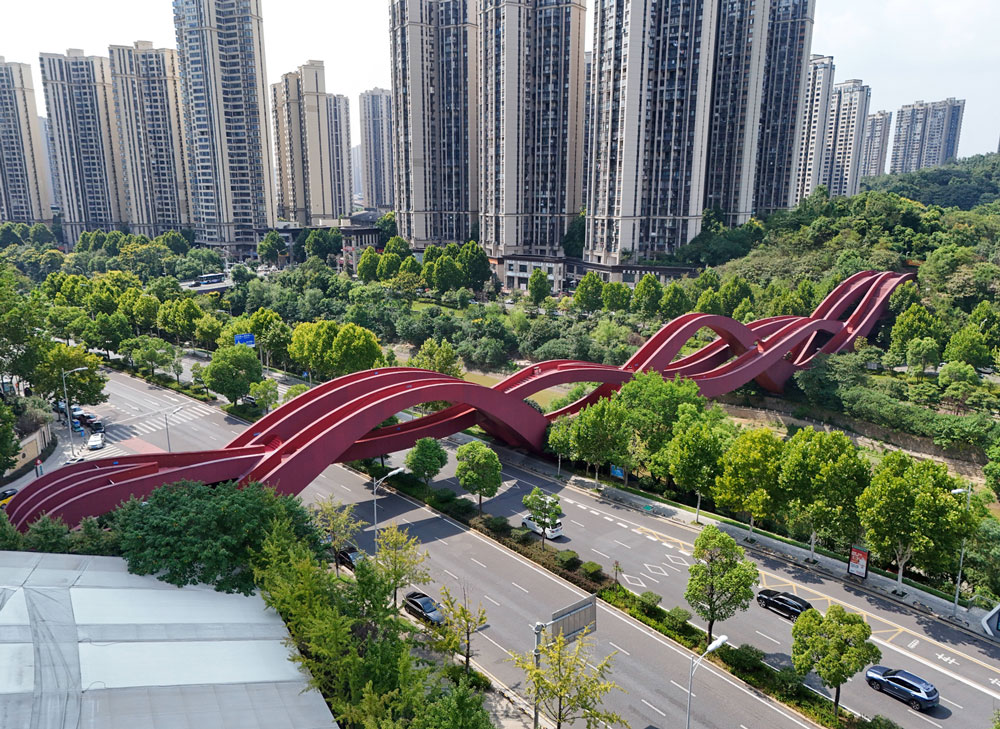
At first glance, the Lucky Knot Bridge in Changsha, China, looks almost impossible to understand. Its bright red structure twists, rises and crosses itself like a giant ribbon suspended above the landscape. Yet the unusual shape is not simply an attempt to create a spectacular landmark. The bridge combines Chinese knotting traditions, the mathematical idea of a Möbius strip and a practical system for connecting several levels of a busy urban area. What looks complicated from a distance is actually a carefully designed piece of engineering.
What If A Bridge Could Look Like A Giant Knot?
Located in the Meixi Lake area of Changsha, Lucky Knot Bridge crosses the Dragon King Harbor River. The pedestrian bridge is approximately 185 meters long and reaches about 24 meters at its highest point. It was designed by NEXT Architects and completed in 2016.
From certain angles, the structure appears to be several bridges tangled together.
That impression is intentional.
The design combines multiple pedestrian routes into one continuous structure. Instead of creating a conventional bridge with a single straight path across the water, the architects created a series of rising and descending paths that intersect and connect at different points.
The result is a bridge that can look completely different depending on where you stand.
From one direction, it resembles a giant red knot.
From another, it looks like a ribbon twisting through the air.
And from above, its geometry becomes easier to understand.
The strange appearance is therefore not the result of an engineering mistake or architectural excess.
The shape is the design.

The Shape Was Inspired By A Möbius Loop
One of the most interesting ideas behind Lucky Knot comes from mathematics.
The architects drew inspiration from the Möbius strip, a famous geometric form with a continuous surface and a sense of endless movement.
The bridge is not literally a Möbius strip, but its design borrows the visual and conceptual idea of continuity. Its paths rise, cross and descend in ways that make it difficult to identify a conventional beginning or end.
For pedestrians, that creates an unusual experience.
A traditional bridge usually tells you exactly what to do.
Walk straight.
Cross the river.
Keep going.
Lucky Knot is different.
The journey itself becomes part of the architecture.
You can climb, turn, cross another section and move toward a different part of the surrounding area. The bridge therefore functions not only as infrastructure but also as a place to explore.
That is one reason the structure looks more like a sculpture than a conventional pedestrian crossing.
Take a closer look at the incredible Lucky Knot Bridge in China — a twisting architectural landmark inspired by both traditional Chinese knots and the Möbius strip.
The Design Wasn’t Just About Mathematics
The Möbius-inspired shape is only half of the story.
The architects also drew inspiration from traditional Chinese knotting.
Chinese decorative knots have long been associated with ideas such as good fortune, prosperity and happiness. The name “Lucky Knot” reflects that cultural connection. The bridge’s strong red color reinforces the symbolism, as red has long carried positive cultural associations in China.
That gives the structure an unusual combination of influences.
One comes from mathematics and abstract geometry.
The other comes from traditional culture.
Together, they produce something that feels both futuristic and familiar.
The bridge is therefore not simply a strange-looking object placed beside a river. Its appearance was intended to communicate ideas about continuity, connection and good fortune.
Even its unusual name is part of the design story.

The Crazy Shape Actually Solves A Real Problem
It would be easy to assume that Lucky Knot was designed primarily to look impressive in photographs.
But its complicated geometry has a practical purpose.
The surrounding area contains different elevations and transportation routes, including the river, roads, parkland and pedestrian paths. The bridge was designed to connect these different levels rather than simply provide one straight crossing.
Its structure incorporates multiple crossing routes and several connection points, allowing pedestrians to move between different areas.
Some of the circular openings in the structure also draw inspiration from moon gates traditionally found in Chinese gardens.
That means the curves are not simply decorative.
They help create the pathways.
The bridge essentially combines several pedestrian movements into a single structure.
This explains something that can be confusing when looking at photographs.
Why does the bridge need to twist so many times?
Because it isn’t designed around just one destination.
It connects several.
The unusual appearance is therefore closely connected to the practical problem the architects were trying to solve.
Building It Was Far Harder Than Making It Look Good
Creating an unusual shape is one thing.
Making that shape safe and functional is another.
Lucky Knot had to satisfy ordinary engineering requirements while maintaining its distinctive geometry. The structure needed to cross the river, provide sufficient clearance and remain comfortable for pedestrians.
The designers also had to coordinate the different paths where they intersected.
The result is a structure in which architecture and engineering cannot really be separated.
The curves determine how people move.
The elevation changes determine how the bridge connects with its surroundings.
The intersections determine how different routes meet.
And the structural system has to support all of it.
That is what makes Lucky Knot more interesting than a simple architectural curiosity.
It looks unusual because it was solving an unusual problem.
The challenge was not simply to make a bridge that people would photograph.
It was to make a bridge that could actually work while maintaining the visual idea that inspired it.
What If A Bridge Was Also A Destination?
Most bridges are designed around one basic purpose: getting people or vehicles from one side to another.
Lucky Knot takes a different approach.
The bridge forms part of the public space around Meixi Lake, connecting pedestrian routes while also creating elevated viewpoints over the surrounding landscape.
Its distinctive shape makes it a landmark in its own right.
At night, lighting can transform the structure into an illuminated feature visible from the surrounding area.
That changes how people experience the bridge.
You don’t necessarily visit Lucky Knot because you need to cross the river.
You might visit because you want to see the bridge itself.
This is an increasingly important idea in modern urban design.
Infrastructure does not always have to disappear into the background. A bridge can become part of a city’s identity, giving people a reason to stop, take photographs and experience the surrounding space differently.
Lucky Knot effectively turns a pedestrian crossing into an attraction.

The Lucky Knot Is More Than A Bridge
There is something satisfying about the way Lucky Knot brings several ideas together.
The mathematics provides the inspiration for its continuous form.
Traditional Chinese knotting provides its cultural meaning.
Engineering makes the complicated geometry functional.
And urban design turns the structure into a public landmark.
From a distance, it looks almost chaotic.
Up close, the logic becomes easier to see.
Every curve has a purpose. Every rise and descent connects different parts of the surrounding area. What initially looks like a giant red ribbon tied into a knot is actually a carefully planned pedestrian system.
And perhaps that is the most interesting thing about Lucky Knot.
A conventional bridge is something you cross because you need to get somewhere.
This one was designed so that the journey itself becomes part of the destination.
Lucky Knot shows that a bridge can be far more than a way to cross a river. By combining the visual language of Chinese knots, the continuous form of a Möbius-inspired design and the practical needs of a growing urban area, its creators turned ordinary infrastructure into a landmark. What first appears to be a tangled red ribbon is actually a carefully engineered network of paths, viewpoints and connections — proving that useful architecture can also become something people simply want to experience.