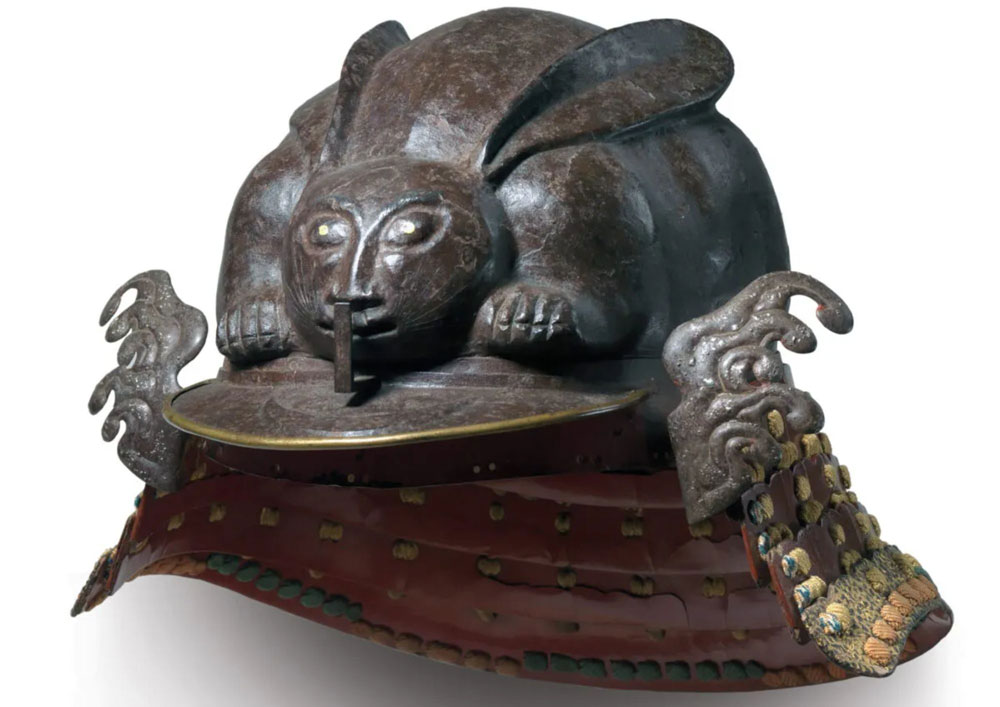
A samurai helmet from 17th-century Japan carries an unusual symbol: a crouching rabbit. At first glance, the image seems almost playful for a piece of battlefield equipment. But the helmet belongs to a distinctive tradition of Japanese armor known as kawari-kabuto, in which warriors used unusual shapes and imagery to express identity and symbolism. In this case, the rabbit may have represented far more than its harmless appearance suggests.
The Samurai Helmet Was Designed Around a Rabbit
The helmet dates to the 17th century, during Japan’s early Edo period, and belongs to a distinctive category of samurai helmets known as kawari-kabuto, or “strange-shaped helmets.” Unlike conventional helmets, these designs incorporated unusual shapes and decorative elements that could make a warrior immediately recognizable.
The most striking feature of this particular helmet is a crouching rabbit positioned above the head. The rabbit was made from a single piece of iron, giving it a strong three-dimensional appearance. The helmet also incorporates shapes resembling waves around the sides.
At first glance, the design seems almost playful. A rabbit is not the creature most people would expect to see on the head of a warrior preparing for battle. But the combination of the rabbit and waves was meaningful within Japanese visual culture.
The image becomes much more interesting when viewed through the symbolism associated with rabbits during the period.

The Rabbit Was Connected to the Moon and the Sea
Rabbit imagery had a long history in Japanese art and literature. One particularly familiar image was the rabbit associated with the moon, a tradition shared across East Asian cultures.
Rabbits were also frequently depicted alongside waves. There was a visual connection between the white foam of ocean waves and the appearance of white rabbits seemingly running across the surface of the water. During the early Edo period, this combination became a recognizable artistic motif.
The connection between rabbits, waves and the moon also appeared in Japanese literature and theater. HistoryNet points to the Noh play Chikubushima, which features imagery of a rabbit associated with the moon and the movement of water.
That context gives the helmet a very different appearance.
The rabbit was not necessarily intended to make its wearer look harmless. Instead, it could connect the warrior to familiar cultural imagery that Japanese viewers would have recognized.
The wave-like elements of the helmet make the interpretation even more compelling. Rather than being an isolated animal decoration, the rabbit appears to have been part of a larger visual theme involving the moon, water and Japanese artistic tradition.
Want to see the unusual samurai helmet and discover why a rabbit was chosen as its symbol? Watch the video to take a closer look at this remarkable piece of Japanese armor and the fascinating story behind its design.
The Rabbit Could Also Symbolize Cleverness and Speed
There was another reason a rabbit could make sense on a samurai’s helmet.
Japanese folklore includes the famous story of the Hare of Inaba, in which a white hare encounters a group of dangerous creatures and ultimately relies on cleverness to survive. The story portrays the hare as an intelligent and resourceful character rather than a physically powerful one.
That distinction is important when considering the helmet in a military context.
A warrior did not necessarily want to symbolize brute strength alone. Speed, agility, intelligence and the ability to outmaneuver an opponent could be equally valuable on the battlefield.
A rabbit is small and vulnerable compared with many predators, but it is also fast and difficult to catch. In that sense, the animal could represent qualities that a warrior might admire: quick reactions, agility and the ability to overcome a stronger opponent through intelligence.
HistoryNet suggests that this may be one possible interpretation of the rabbit on the helmet, although there is no definitive evidence establishing exactly what the original wearer intended.
That uncertainty is part of what makes the helmet so fascinating.
We can understand the symbolism surrounding the rabbit, but we cannot know with certainty which particular meaning mattered most to the samurai who wore it.

Samurai Helmets Were More Than Protective Equipment
The rabbit helmet also demonstrates an important aspect of samurai armor.
A helmet was obviously designed to protect the warrior’s head, but it could also become a highly visible expression of identity. Kawari-kabuto allowed warriors to move beyond conventional designs and incorporate distinctive shapes, animals and objects.
On a battlefield filled with armored warriors, an unusual helmet could make its wearer stand out immediately.
That visual identity may have had practical and psychological value.
The warrior could be recognized more easily by allies, while an unusual design could communicate something about his personality or aspirations. A fierce-looking helmet could emphasize strength or intimidation, while a more unusual symbol could communicate a different set of qualities.
The rabbit therefore did not have to represent weakness.
It could represent exactly the opposite.
A warrior might choose an animal associated with speed because he wanted to emphasize agility. He might appreciate its association with cleverness and deception. Or he might simply have been attracted to the rabbit’s place in Japanese mythology and artistic tradition.
Without a written record from the original owner, all of these interpretations must remain possibilities rather than certainties.
This Samurai Chose a Rabbit Instead of a Dragon
The contrast is what makes the helmet so memorable.
Dragons, demons and other powerful creatures are obvious choices for warriors. They immediately communicate strength, danger and supernatural power.
The rabbit sends a different message.
It is smaller, faster and more subtle.
Instead of saying “I am the strongest creature on the battlefield,” the symbol could suggest “I am difficult to catch, quick to react and capable of outsmarting my opponent.”
That would fit a broader understanding of warfare in which strategy and timing could be just as important as physical power.
The rabbit’s connection to the moon and sea adds another layer. The warrior was not necessarily choosing between a cute animal and a frightening one. He was selecting an image with established cultural associations that could carry several meanings at once.
That is one of the reasons historical objects can be so revealing.
A modern viewer may see a strange rabbit sitting on top of a helmet. A person familiar with the cultural context might see references to mythology, literature, nature and desirable personal qualities.
The object therefore tells us something about how samurai could use clothing and armor to communicate.
The Meaning of the Rabbit Remains a Mystery
Despite all the possible interpretations, there is no definitive answer explaining why this particular samurai chose the rabbit.
It may have been inspired by the moon rabbit tradition. It may have referred to the relationship between rabbits and waves. It may have represented cleverness and agility. It may have combined several of these ideas.
Or the owner may simply have liked the design.
What can be said with greater confidence is that the rabbit was not necessarily an arbitrary choice. Rabbit imagery had an established place in Japanese culture, particularly in art and literature during the period.
The helmet therefore deserves to be understood within that cultural environment rather than judged by modern expectations of what a warrior’s equipment should look like.
Its unusual appearance is precisely what makes it valuable. It demonstrates that samurai armor could be functional, personal and symbolic at the same time.

The rabbit on this 17th-century samurai helmet may look like an unusual choice for a warrior, but its symbolism was far more meaningful than it first appears. In Japanese culture, the rabbit could be connected to the moon, waves, cleverness and agility, giving the design several possible interpretations. Although we may never know exactly why its owner chose the symbol, the helmet shows how samurai armor could express personality and cultural identity as much as it provided protection.