Buffalo Bill Cody helped turn the American West into an international spectacle when his Wild West show traveled to Europe. Decades later, Italy would take that uniquely American mythology in an unexpected direction, transforming cowboys and frontier stories through Spaghetti Western films and Italian craftsmanship. But how did an American legend inspire an Italian fascination that eventually found its way back across the Atlantic?
When Buffalo Bill Took the American West to Italy
Buffalo Bill Cody became one of the most recognizable figures associated with the American West, but his story reached far beyond the American frontier. At the end of the 19th century, Cody took his Wild West show across the Atlantic, giving European audiences a spectacular version of the American frontier—and Italy became one of the places where that image made a lasting impression.
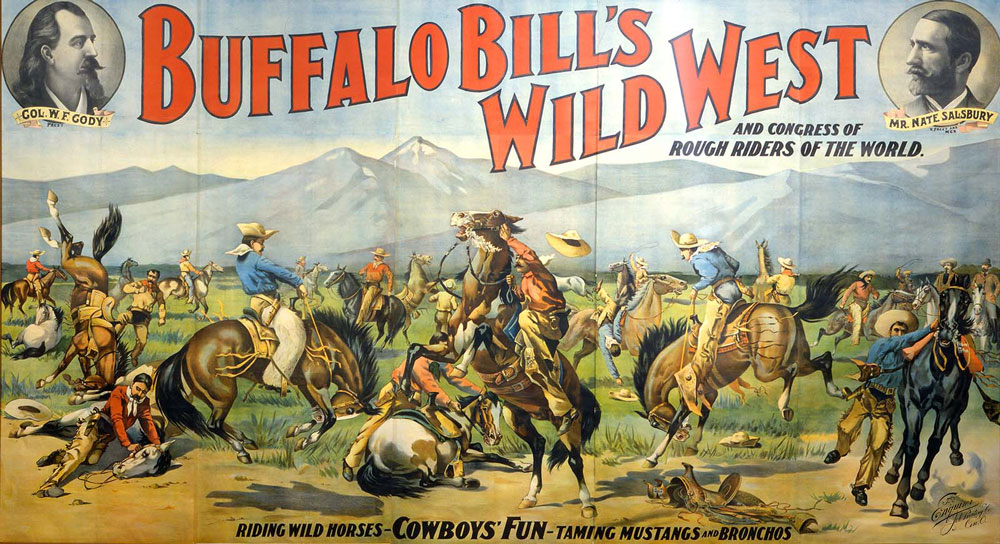
Buffalo Bill’s Wild West combined horseback riding, marksmanship, Native American performers, cowboys and staged scenes inspired by life on the frontier. It was entertainment, but it also presented audiences with a carefully constructed picture of what the American West looked like.
Cody first brought the show to Europe in 1890. He returned for another major European tour in 1906, which became his final visit to the continent. During these tours, Italian audiences in cities including Rome and Bologna had the opportunity to see the spectacle firsthand, rather than encountering the American frontier only through stories, illustrations or newspapers.
It would be too simple to say that Buffalo Bill created Italy’s fascination with the American West. Italy already had its own cultural interests and connections to frontier stories. But Cody’s performances helped introduce a vivid and highly theatrical version of American Western life to European audiences.
That exchange would eventually take an unexpected direction. Decades later, Italian filmmakers, artists and craftsmen would reinterpret the American West in their own way—and some of those ideas would eventually travel back across the Atlantic.
How did an American showman help inspire an Italian fascination with the Old West that would eventually return to America in an unexpected form?

The Old West Became an Italian Obsession
The American West did not remain an American story for long. After images of cowboys, frontier towns and horseback riders reached European audiences, the fascination continued long after Buffalo Bill’s shows had left the stage. By the 20th century, Italy would become one of the most important places for reinventing the Western on screen.
This new style became known as the “Spaghetti Western,” a term commonly used for Western films made primarily by Italian filmmakers. Many were filmed in Italy and Spain, where landscapes could stand in for the American frontier. The films often looked and felt different from traditional Hollywood Westerns, with darker stories, distinctive visual styles and memorable characters.
The genre reached its golden era from roughly 1964 to 1978. Actors including Clint Eastwood and Lee Van Cleef became closely associated with the movement, while films such as A Fistful of Dollars introduced audiences around the world to a distinctly Italian interpretation of the American frontier.
What makes the story fascinating is that Italy did not simply imitate Hollywood. Italian filmmakers took familiar American symbols—the cowboy, the gunslinger, the dusty frontier town—and reshaped them through their own filmmaking traditions.
In doing so, they helped turn the Old West into something larger than a piece of American history. It became an international cultural myth, recognizable to audiences who had never lived anywhere near the American frontier.
So what happens when another country takes one of America’s most recognizable myths and tells the story its own way?
Buffalo Bill Cody helped turn the American West into a legend—but how much of that legend was actually true? Watch the video below to discover the man behind the myth, his Wild West show, and how he helped bring the story of the American frontier to audiences around the world. Buffalo Bill Cody: The Greatest Lie of the American Wild West?
From Movie Screens to Italian-Made Old West Replicas
The connection between Italy and the American West took another unexpected turn in the 20th century. It was no longer just about movies. American enthusiasts who wanted to experience or recreate aspects of the Old West increasingly faced a practical problem: original historical firearms were becoming scarce, expensive and difficult to obtain.
One of the people who helped change that was Val Forgett Jr., founder of Navy Arms. During the period surrounding the Civil War centennial, interest in historical reenactment was growing, but authentic examples of many 19th-century firearms were not readily available. Forgett began looking toward Italy, where manufacturers had developed considerable expertise in producing historical replicas.
In 1959, Italian maker Uberti began producing replica firearms under its own name, helping establish a manufacturing connection between Italian craftsmanship and American interest in the Old West. Navy Arms later introduced replicas based on famous historical designs, including reproductions of the Winchester Model 1866 and Model 1873 in the 1970s.
Over the following decades, other Italian manufacturers, including Pietta and Pedersoli, became part of the replica market.
The fascinating part is not the technical details of these products. It is the cultural exchange behind them. Designs associated with American history were being recreated by Italian craftsmen and eventually sold back to an American audience.
The cycle had come full circle:
American West → Italy → Western films → Italian craftsmanship → America.
What began as an American frontier story had become an international cultural legacy.

How Italy Helped Keep the Old West Alive
By this point, the story is no longer simply about Buffalo Bill, Western movies or Italian-made replicas. It is a story of cultural exchange—and of how an American image could travel overseas, change along the way, and eventually return home in a new form.
Buffalo Bill helped bring a highly recognizable version of the American West to European audiences. Italy then absorbed those images and reinterpreted them through film, art and craftsmanship. The result was the Spaghetti Western, a distinctive cinematic tradition that introduced new generations around the world to cowboys, frontier towns and the mythology of the American West.
Italian manufacturers also played a role in preserving interest in historical Old West designs through replica production. For collectors, historians and enthusiasts, these reproductions helped keep familiar 19th-century designs visible long after the original era had disappeared. Some experienced collectors can even distinguish Italian reproductions from original historical examples through differences in details and construction.
But the larger story is cultural, not technical.
American culture is often exported around the world, but it does not always return unchanged. Other countries reinterpret American ideas through their own traditions, industries and creative perspectives. In this case, Italy helped transform the mythology of the American frontier into something that could travel back across the Atlantic.
The Old West may have been born in America, but part of the reason its image survived so strongly may have come from the people who saw it from the other side of the Atlantic.
The story of Buffalo Bill and Italy reveals how a piece of American culture can travel far beyond its original borders and return in a completely different form. What began with an American showman presenting the frontier to European audiences eventually influenced Italian cinema, craftsmanship and the way generations of people imagined the Old West. America created the myth, but Italy helped reinterpret and preserve it. In the end, the Old West became more than American history—it became a cultural story the world helped keep alive.