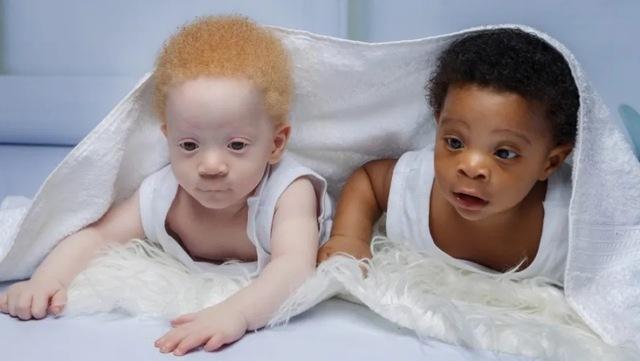
When Daniel and David were born in Lagos, Nigeria, on February 26, 2019, their parents were expecting the usual surprise of meeting twins for the first time. What they did not expect was to see two baby boys with dramatically different coloring. Daniel had dark skin and black hair, while David had very pale skin and golden hair because he was born with albinism. Their unusual appearance quickly attracted attention online, but behind the striking photographs is a story about genetics, family, and learning to see beyond appearances.
The Birth That Left the Family Surprised
Stacy and Babajide Omirin, a couple from Lagos, already had an older daughter, Demilade, when they learned they were expecting twins. Stacy later said that the pregnancy scans had not revealed anything unusual about the babies’ pigmentation, so she was not prepared for the visual difference when the boys were delivered by cesarean section. Daniel arrived first with dark hair and skin, followed shortly afterward by David, whose pale complexion and golden hair immediately made the contrast obvious.
The family later recalled that the medical staff were surprised as well, with Stacy saying nurses came to look at the babies after seeing how different they appeared. Their father also reacted with amazement and affection, giving David the nickname “Golden.” The surprise was not about whether both babies belonged to the family—it was about how dramatically genetics could shape their appearance even when the boys were born together.
Meet Daniel and David! Born minutes apart in Lagos, these incredible twins share a bond deeper than appearance. Watch their heartwarming story of family, love, and unique beauty! Watch
Why Did the Twins Look So Different?
The answer lies in David’s albinism. The family has described him as having oculocutaneous albinism, a group of inherited conditions that affect the production of melanin, the pigment responsible for much of the color in skin, hair, and eyes. Reduced melanin can produce very light skin and hair, while albinism can also involve the eyes and affect vision.
This is an important distinction because albinism is a genetic condition, not a racial identity and not something caused by the parents’ diet, environment, or behavior. Non-syndromic oculocutaneous albinism is generally inherited in an autosomal-recessive pattern, meaning a child can inherit relevant variants from parents who may not show the condition themselves. Different genetic forms can produce different amounts of pigmentation, so the appearance of someone with albinism can vary considerably from one person to another.

Were Daniel and David Really Identical Twins?
This is one area where the popular retelling of the story requires some caution. Articles about the family have repeatedly described Daniel and David as identical twins, and their mother has also referred to them that way, but the widely circulated accounts do not provide publicly documented genetic testing that independently establishes whether the boys are monozygotic. What is firmly documented is that they were twin brothers born minutes apart and that David was born with albinism, producing the striking difference that made their story famous.
The distinction is scientifically important because “identical twins” has a specific biological meaning: monozygotic twins originate from the same fertilized egg and generally share nearly all of their DNA. Even monozygotic twins can develop differences because of genetic mutations occurring after the embryo begins dividing, epigenetic changes, and different developmental processes. In other words, dramatic differences in appearance do not automatically disprove an identical-twin relationship, but the specific biological explanation for these brothers cannot be established from photographs or media reports alone.
David’s Appearance Was More Than a Visual Difference
Albinism can affect more than skin and hair pigmentation. According to GeneReviews, oculocutaneous albinism is commonly associated with ocular abnormalities because melanin also plays an important role in the developing visual system. Possible features include reduced visual acuity, sensitivity to light, involuntary eye movements, and other differences in how the eyes and optic pathways function.
That medical context is often missing from viral stories about people with albinism. The most visible characteristic may be extremely light skin or hair, but the condition is fundamentally genetic and can involve lifelong vision-related needs. Public accounts of David’s childhood said his mother considered him healthy, but a media profile cannot substitute for a medical assessment, and the exact clinical details of his condition have not been publicly documented in the sources available for this story.

Growing Up Under a Spotlight
The boys’ unusual appearance quickly attracted attention whenever the family went out in Lagos. Their mother described people staring, whispering, asking questions, and sometimes even asking which child was hers, illustrating how unfamiliar the combination of appearances was to some members of the public. For Stacy, those moments became opportunities to explain that both boys were her sons and that their differences in appearance did not make one less connected to the family than the other.
At home, however, the emphasis was much more ordinary. Stacy described Daniel as more expressive and playful, while David was portrayed as more observant and selective, showing that the brothers also developed different personalities that had nothing to do with their pigmentation. Her comments highlighted a point easily lost in viral photographs: siblings can be visually strikingly different while still sharing the ordinary habits, arguments, jokes, preferences, and affection that define family life.

Social Media Turned Two Brothers Into a Global Story
Stacy and Babajide created an Instagram account for Daniel and David partly because they believed the boys had a story to share and partly to raise awareness about albinism. Photographs of the brothers in matching outfits, traditional clothing, birthday celebrations, and everyday family moments began circulating widely, and the account quickly attracted an audience far beyond Nigeria. Their story was subsequently republished by international media outlets, turning a private family surprise into a global human-interest story.
The account also changed the way people encountered the family. Instead of seeing one isolated photograph and inventing their own explanation, followers could watch the boys grow and see their relationship develop over time. That continuity mattered because it shifted the focus from “two babies who look different” toward two brothers with individual personalities and an ordinary family life.
The Family Used Attention to Encourage Awareness
One of the more constructive aspects of the story is the way Stacy used the attention to talk about albinism rather than simply treating the boys’ appearance as a curiosity. She told interviewers that she wanted people to understand why her sons looked different and to see both children as equally deserving of love, respect, and opportunity. The family’s social-media presence therefore became not just a showcase of unusual photographs but also an informal platform for awareness and acceptance.
That message matters because albinism is still poorly understood in many parts of the world. The condition is sometimes surrounded by myths and stigma, while people with albinism can face social discrimination as well as practical challenges such as light sensitivity and visual impairment. Medical organizations emphasize that albinism is a genetic condition and that appropriate eye care, sun protection, and supportive healthcare can be important parts of managing it.

Why Their Story Became So Fascinating
The initial fascination is easy to understand. Two children are born minutes apart, they are reported by their family as identical twins, and yet one has dark skin and hair while the other has very pale skin and golden hair. That visual contrast creates an immediate mystery, especially for people unfamiliar with albinism and the genetics of pigmentation.
But the story becomes much more meaningful once the mystery is explained. The brothers are not simply a viral photograph or a biological curiosity; they are a family navigating a genetic condition, public attention, and the ordinary process of raising children. Their story demonstrates how science can explain something that initially appears almost impossible while also reminding us that a medical condition should never become the entirety of a person’s identity.

What Daniel and David’s Story Really Shows
The most interesting lesson is not that two twins can look different. Human genetics is far more complicated than the simplified idea that family resemblance must always be obvious. The deeper lesson is that appearance can tell us surprisingly little about a person’s biology, personality, or place within a family.
Daniel and David’s photographs became famous because the contrast was immediately visible, but the family’s own descriptions repeatedly returned to the same idea: the boys are brothers first. Their story brought attention to albinism, challenged assumptions about what twins “should” look like, and showed how a family’s response to an unexpected difference can shape the way the wider public understands it.


Daniel and David’s story began with a remarkable moment in a Lagos delivery room, when two brothers born minutes apart appeared to have dramatically different pigmentation. David’s albinism explains the most visible difference, while the broader genetics of albinism show why skin and hair color can vary so extensively. Yet the lasting appeal of their story comes from more than biology. Their family turned an unexpected birth story into a message about acceptance, awareness, and individuality, reminding millions of viewers that what makes two siblings different on the outside says very little about how deeply they can be connected.