Walk through a modern supermarket and you are looking at the result of one of humanity’s longest-running experiments. The sweet corn, seedless bananas, orange carrots, enormous tomatoes, and creamy avocados surrounding us are not simply untouched products of nature. Over thousands of years, people repeatedly saved seeds, selected desirable plants, moved crops across continents, and gradually changed what those plants looked and tasted like. Long before modern genetics existed, humans were already reshaping plant evolution—one harvest at a time.
Corn: From Wild Teosinte to a Global Staple
Modern corn began as teosinte, a wild grass native to Mexico that looks remarkably different from the familiar ears sold today. Archaeological and genetic evidence places the early stages of maize domestication in southern Mexico roughly 9,000 years ago, when Indigenous farmers began selecting plants with traits that made the seeds more useful to humans. The change was gradual rather than instantaneous, with semi-domesticated forms spreading while selection continued in different regions.
That makes maize one of the clearest examples of humans acting as evolutionary partners rather than passive consumers. Early farmers repeatedly favored larger and more productive plants, eventually producing a crop capable of supporting dense populations and traveling far beyond its original range. Ancient DNA now shows that maize domestication was more complicated than a simple one-way journey from Mexico, with later movement and genetic exchange helping create the extraordinary diversity of maize grown around the world.

Banana: The Fruit We Changed by Removing Its Biggest Problem
Wild bananas are a striking reminder that “natural” does not necessarily mean convenient. Many wild banana relatives contain large, hard seeds that occupy much of the fruit, making them very different from the smooth, mostly seedless bananas found in grocery stores. Domestication in Southeast Asia involved selecting plants with more edible flesh and fewer usable seeds, eventually producing the seedless cultivated bananas that became important throughout the tropics.
But even the modern banana has a complicated evolutionary story. The Gros Michel variety once dominated international trade before a fungal disease devastated plantations, after which Cavendish varieties became the industry standard because of their resistance to the particular disease strain. Cavendish bananas are themselves largely clonal, which illustrates another side of domestication: the same human decisions that create uniformity and convenience can also reduce genetic diversity and increase vulnerability to future threats.

Ever wonder how your favorite fruits and veggies looked before modern farming? From toxic wild cucumbers to tiny, seed-filled bananas, humans have drastically transformed our food over centuries. Curious to see the evolution? Watch this fascinating breakdown of the top 10 foods that have changed the most!
Apple: From Wild Fruit to Orchard Standard
The apple has one of the most fascinating domestication histories because its wild relatives remain recognizable today. Wild apples in Central Asia, particularly Malus sieversii in the Tian Shan region, contributed substantially to the ancestry of cultivated apples, while later human movement and hybridization brought together genetic material from different populations. Rather than one isolated moment of domestication, the modern apple emerged through a long history of cultivation, selection, trade, and genetic mixing.
Humans also learned to preserve desirable apple traits through grafting, allowing growers to reproduce trees with particular qualities rather than relying entirely on unpredictable seeds. This practice helped maintain specific varieties over generations and made orchards far more consistent. The result is the supermarket landscape we know today, where Gala, Fuji, Granny Smith, and many other apples descend from centuries of human selection and movement rather than from a single wild ancestor untouched by cultivation.

Lemon: A Citrus Hybrid With a Complicated Family Tree
The lemon is an especially good example of how human food history is intertwined with hybridization. Modern lemons are generally understood as descendants of ancient citrus combinations involving citron and sour orange, rather than as a completely separate wild species that simply emerged in its current form. Their history reflects the movement of citrus plants through Asia and the Mediterranean, where farmers and traders carried varieties into new environments and continued selecting useful traits.
The process highlights an important point about domestication: humans did not always start with a wild plant and simply make it bigger or sweeter. Sometimes they brought different plants together and then selected the offspring they preferred. Over generations, those combinations became stable enough to form the familiar fruits that now seem completely natural and inevitable.

Cabbage: One Wild Plant Became an Entire Vegetable Family
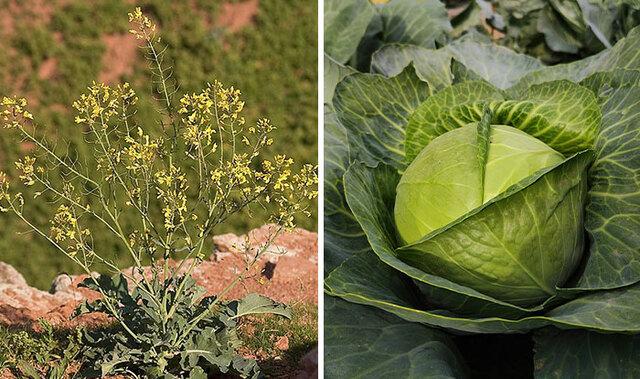
Few examples demonstrate human selection more dramatically than Brassica oleracea. The wild form is a leafy plant that grows naturally along the rocky coasts of Europe, but selective breeding transformed it into a remarkable collection of vegetables. Choose different parts of the plant for particular traits and you can eventually produce cabbage, kale, broccoli, cauliflower, Brussels sprouts, and kohlrabi.
What looks like a collection of completely unrelated vegetables is therefore, in large part, the result of humans repeatedly choosing which characteristics they wanted to preserve. Some varieties emphasized leaves, others enlarged flower structures, while others developed swollen stems or compact heads. It is one of the clearest demonstrations that domestication is not simply about making a wild plant “better”; it is about steering the same biological raw material in radically different directions.

Plum: From Ancient Fruit to a Family of New Hybrids
Plums belong to one of the oldest groups of cultivated fruit in Eurasia, with domestication histories tied to ancient agricultural communities in the Near East and surrounding regions. Humans valued them because they could be eaten fresh, dried, stored, and transported, making them useful long before modern refrigeration or food distribution. Over time, cultivation produced many different plum types adapted to different climates, tastes, and culinary traditions.
Later breeding took the process further. Hybrid fruits such as the pluot—created by crossing plums and apricots—show that plant improvement did not stop with ancient agriculture. Modern horticulture simply gave humans more precise tools for doing what farmers had been doing for millennia: combining desirable characteristics and selecting the offspring that best matched what people wanted to eat.

Ever wonder if your grocery haul is actually a human invention? From the surprising origins of broccoli to the truth about carrots and corn, many “all-natural” foods are actually results of centuries of careful engineering. Dive into the fascinating history of your favorite produce in this eye-opening video!
Carrot: Why Did the Carrot Become Orange?
The ancestors of today’s carrot were far less uniform in appearance. Early cultivated carrots could be purple, yellow, white, or other colors, and their roots were generally thinner and less standardized than the smooth orange carrots common today. The orange carrot became dominant in Europe through centuries of breeding, particularly in the Netherlands, where orange varieties became strongly associated with Dutch cultivation.
The popular story that Dutch growers created orange carrots specifically to honor the House of Orange is widely repeated, but the historical evidence is less certain than the legend suggests. What is clear is that selective breeding gradually favored orange, sweeter, more uniform roots, while growers also selected against branching and woody characteristics. The result was a vegetable that looks so natural today that it is easy to forget how thoroughly humans shaped it.

Cucumber: From Bitter Defense Mechanism to Salad Staple
Wild cucumbers were very different from the crisp, mild vegetables served in salads today. Many wild relatives were smaller, rougher, and significantly more bitter because they contained cucurbitacins—compounds that plants use as defenses against herbivores. Human selection gradually favored plants with reduced bitterness, more edible flesh, and characteristics that made cultivation and consumption easier.
Modern breeding continued that process by selecting traits such as thin skin, mild flavor, and reduced bitterness. So-called “burpless” cucumbers became another example of breeders responding to consumer preferences rather than simply natural selection. The cucumber’s transformation is a small but telling example of how often the food on our plates has been shaped around human convenience.

Watermelon: From Survival Fruit to Summer Icon
The watermelon also underwent a remarkable transformation. Wild relatives from Africa were not simply smaller versions of today’s supermarket melons; many had pale or differently colored flesh and were valued in part for their water content. Over generations, cultivation selected for characteristics that made the fruit increasingly useful as food, including larger size, sweeter flesh, and changes in the color and texture of the interior.
Evidence from ancient Egypt shows that domesticated watermelon was already being cultivated thousands of years ago. Genetic work on a roughly 3,500-year-old Egyptian sample indicates that New Kingdom Egyptians had access to red-fleshed watermelon, suggesting that some of the features we associate with modern watermelon were already emerging in antiquity.

Before they were sweet and juicy, modern fruits and veggies were completely unrecognizable. Watch this quick video to explore how centuries of selective farming turned tiny, bitter wild plants into the everyday produce on your plate today.
Peach: Thousands of Years of Selection Packed More Fruit Into Every Bite
Peaches originated in China, where their domestication began several thousand years ago. Their wild ancestors were much smaller and produced less flesh relative to the stone, meaning that a modern peach would have looked extraordinarily generous by comparison. Through long-term selection, farmers favored larger fruit, sweeter flavor, and a more useful balance between flesh and pit.
The familiar distinction between clingstone and freestone peaches is itself linked to selective breeding. In one type, the flesh remains attached to the stone; in the other, it separates much more easily. What may seem like a minor eating preference is actually another example of humans steering plant biology toward specific practical outcomes.

Avocado: The Fruit That Survived After Its Original Partners Disappeared
The avocado’s story reaches back to a world of giant Ice Age animals. Wild avocados evolved alongside large mammals that could swallow the fruit and disperse its enormous seed, but many of those megafauna disappeared. Humans later became important agents in preserving and spreading the fruit, selecting trees that produced more edible flesh and more useful characteristics.
Modern avocado production then took another major step when particular varieties were propagated for commercial cultivation. The Hass avocado, which emerged from a California seedling selected by Rudolph Hass in the early twentieth century, became especially important because of its flavor, texture, productivity, and suitability for shipping. Today, the familiar dark, bumpy Hass avocado dominates international markets, showing how a single cultivated line can reshape a global food category.

Grapes: The Fruit That Helped Build Entire Civilizations
Grapes were among the important crops domesticated in Western Asia and the Caucasus around 11,000 years ago, according to genetic research. People did not simply make grapes larger; they selected for traits such as berry size, sweetness, palatability, reproductive characteristics, and eventually suitability for wine production. The result was a family of plants that became deeply connected to agriculture, trade, religion, and social life across Eurasia.
Grapes also demonstrate that domestication can serve different purposes simultaneously. Some varieties were shaped for eating, others for drying, and others for fermentation. Human selection and movement created thousands of cultivars adapted to different climates and uses, turning one wild lineage into a global agricultural system whose products include table grapes, raisins, and wine.

Eggplant: From Spiny Wild Relative to Kitchen Staple
Eggplant belongs to the nightshade family and has a long domestication history in Asia. Earlier cultivated forms differed substantially from many modern varieties, while wild relatives could have more defensive structures and smaller fruits. Over generations, farmers favored larger edible fruits, less bitterness, fewer spines, and shapes that were easier to harvest and prepare.
The name itself hints at some of the vegetable’s earlier diversity. Some historical forms were white and egg-shaped rather than the long, dark-purple varieties that dominate many supermarkets today. The modern eggplant is therefore not a single natural form but the product of generations of breeding across Asia, the Middle East, and later Mediterranean agriculture.

Tomato: From Tiny Wild Berry to Global Powerhouse
The modern tomato is another extraordinary case of scale. Wild relatives such as Solanum pimpinellifolium still produce tiny fruits in parts of South America, dramatically smaller than the large tomatoes sold today. Domestication and subsequent breeding increased fruit size and changed characteristics such as color, shape, texture, and productivity, eventually producing the extraordinary range of tomatoes found in global agriculture.
The tomato’s history also illustrates the role of movement. Plants originating in the Americas eventually traveled to Europe and then across the world, where different cultures incorporated them into cuisines that now seem inseparable from the ingredient. The modern tomato is therefore both a biological product of selection and a cultural product of centuries of human exchange.

What the Supermarket Really Tells Us About Human Evolution
The history of these 14 crops reveals that domestication was not a single revolution that ended once humans began farming. It was—and remains—an ongoing process. Farmers selected seeds, moved plants into new climates, crossed different varieties, and preserved traits they considered valuable, gradually changing crops at the genetic level over thousands of years. Modern plant breeding continues the same basic process with increasingly precise scientific tools.
That is why the distinction between “natural” food and “human-made” food can be misleading. Virtually every major crop on which modern societies depend has been shaped by human selection to some degree, often for thousands of years. Agriculture did not simply give people more food; it changed the biology of the plants themselves, creating the flavors, textures, colors, and shapes that now feel completely ordinary.
The next time you bite into a sweet peach, slice an avocado, peel a banana, or cut into a tomato, you are tasting the result of an evolutionary partnership between humans and plants. For roughly 10,000 years, people have selected, propagated, traded, crossed, and cultivated plants to make them more useful, productive, palatable, and adaptable. Some changes were tiny and gradual; others transformed wild grasses and bitter fruits into global staples. The modern supermarket is therefore more than a place to buy food—it is a living archive of human ingenuity written into the biology of the plants we eat.