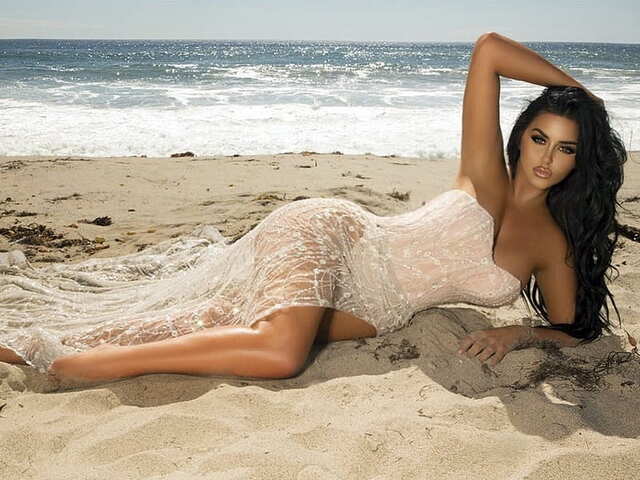
Before Instagram became one of the world’s most powerful celebrity-making machines, Abigail Ratchford was already experimenting with a different formula: create attention first, build the audience yourself, and then turn that audience into a business. Her breakthrough came in 2013, when photographs from a shoot in Philadelphia began spreading online and attracted attention far beyond Pennsylvania. What followed was more than a modeling career—it was an early example of how a person could turn social media into a personal media company.
The Moment a Local Photo Shoot Changed Everything
Ratchford was born and raised in Scranton, Pennsylvania, far from the traditional centers of American entertainment. Her path into modeling was not built around a major agency discovering her or a studio handing her a breakthrough role. Instead, photographs from a shoot with a local Philadelphia photographer went viral in 2013, giving her an unexpected opening into the rapidly changing world of online celebrity.
The important part came after the attention arrived. In an interview with Maxim, Ratchford explained that she spent one to two hours a day contacting websites and sending them her photographs, effectively acting as her own manager and publicist during her first year. That was a remarkably hands-on approach for someone entering an industry traditionally built around agents, editors, and established gatekeepers.
That early decision shaped almost everything that followed. Instead of waiting for the entertainment industry to decide whether she was marketable, Ratchford began testing the market herself. She was not simply producing photographs; she was learning where those photographs traveled, which audiences responded to them, and how attention could be converted into more opportunities.
High energy, good vibes, and something you don’t want to miss! I just dropped a brand-new video, and it’s packed with insights you’ll love. Hit the play button now, drop a comment with your thoughts, and don’t forget to share with a friend! Watch the full video here:
She Realized the Audience Was the Real Asset
By 2016, Ratchford had accumulated nearly five million Instagram followers, according to Maxim. She described her growth as a combination of viral videos, relationships with media outlets such as TMZ, frequent visual content, and glimpses into her ordinary life. The strategy was straightforward but powerful: give people a reason to share the content while also giving them enough access to feel connected to the person behind it.

Her understanding of platforms was unusually deliberate for the period. In another interview, she described Instagram as a kind of public portfolio while emphasizing Twitter as a place where she could communicate more directly with followers. She also explained that Snapchat allowed her to provide behind-the-scenes material, while Instagram could remain more polished and curated.
That distinction matters because Ratchford was effectively learning an early version of what creators now call platform strategy. Different channels served different purposes: one could showcase the finished product, another could build intimacy, and another could drive discovery. Long before influencer marketing became a formal industry, she was already treating distribution as part of the creative process.

From Model to Brand: The Business Behind the Photos
The next step was more ambitious than simply gaining followers. Ratchford began using her audience to support products and projects directly associated with her own name. Entrepreneur reported in 2019 that she sold branded products through her website and had launched an app designed to provide exclusive and bonus content to fans.

This model represented a major shift in the economics of celebrity. Traditionally, a model might earn money from magazine shoots, appearances, campaigns, or agency bookings while the audience remained largely controlled by publishers and broadcasters. Ratchford’s approach placed more of the relationship between celebrity and consumer in her own hands. Her followers were no longer simply an audience; they could become customers.
She also spoke openly about wanting to emphasize her own products rather than filling her feed with endless outside endorsements. In a 2016 Maxim interview, she said she preferred promoting things such as her calendar, merchandise, and swimsuit issue because maintaining authenticity mattered to her. Whether every decision succeeded commercially is difficult to establish from public records, but the underlying strategy was clear: build an identity people recognize, then monetize the identity itself.

You don’t want to miss this! Check out our latest video now for an inside look. Tap the link in the bio to watch the full clip!
Why Her Personal Style Became a Business Advantage
Ratchford’s visual identity was central to the model. She developed a recognizable aesthetic around glamour, fashion, travel, beauty, and polished photography, giving audiences a consistent reason to follow her even when there was no magazine cover or major television appearance to promote. Muscle & Fitness noted her stated preference for building her own brand and earning from her own products rather than relying primarily on conventional Instagram endorsements.
That consistency gave her something many internet personalities struggle to create: recognizability. A follower could encounter one photograph without seeing a username and still understand the style behind it. In a crowded visual marketplace, that kind of consistency functions almost like a corporate logo—it makes the product immediately identifiable.
Her own explanation of audience growth also reveals how much experimentation was involved. She has said she watched what followers responded to, mixed professional shoots with selfies and personal material, and tried to keep the feed from becoming repetitive. In other words, the image may have looked effortless, but maintaining the image was part of the work.

The Leap From Internet Celebrity to Mainstream Entertainment
The internet did not remain the only stage. Ratchford expanded into mainstream entertainment through magazine appearances, television work, and acting opportunities, including a credited appearance on NBC’s Parks and Recreation. IMDb identifies her as an American model and aspiring actress who became widely known after her 2013 breakthrough.
Her name also appeared repeatedly in major men’s lifestyle and entertainment publications, including Maxim, Esquire, and Sports Illustrated-related coverage. Maxim later described her as an Instagram-famous influencer and highlighted projects including her 2021 black-and-white coffee-table book, AR Black and White.
This crossover mattered because it created a feedback loop between old media and new media. Traditional publications gave internet fame additional legitimacy, while social platforms gave those traditional appearances a much larger distribution network. Instead of choosing between Hollywood-style exposure and direct-to-fan media, Ratchford operated in the space between the two.

What Made Her Approach Different From a Typical Influencer
The most interesting part of Ratchford’s career is not simply that she became famous online. Plenty of people have experienced viral attention and then disappeared almost as quickly. Her more durable achievement was recognizing that attention had to be converted into an ongoing relationship with an audience.
In interviews, she repeatedly emphasized audience interaction and learning what followers wanted. She discussed using Q&As, giveaways, behind-the-scenes material, and more personal communication to maintain engagement, while also arguing that creators should remain consistent with their own brand. Those ideas now sound standard in influencer marketing, but they were considerably less established when she was building her following.
That helps explain why her story is more interesting than a simple “Instagram model becomes famous” narrative. Her career illustrates an early version of the creator-business model in which the individual is simultaneously the talent, the publisher, the marketing department, and the distribution channel. The photographs created attention, the social platforms retained the audience, and the products gave that audience somewhere to go next.

The Real Legacy of the Abi Ratchford Strategy
Ratchford’s career arrived at a turning point in celebrity culture. The old system depended heavily on casting directors, magazine editors, television executives, and modeling agencies, while the emerging system allowed individuals to publish directly to millions of people. Her success did not eliminate the traditional entertainment industry, but it demonstrated that someone could build significant visibility without waiting for traditional gatekeepers to provide the first opportunity.

Her influence is therefore better understood as a case study in personal branding than simply a story about modeling. The specific platforms have changed, follower counts fluctuate, and new creators emerge every day, but the fundamental strategy remains familiar: establish a distinctive identity, understand the audience, control distribution where possible, and create multiple ways for attention to generate revenue.
Ratchford’s career also shows the risk behind that model. A personal brand can be powerful precisely because it is personal, but that means the creator must continually maintain the identity that attracted the audience in the first place. What began as a viral photo shoot became a long-running career because she continued turning visibility into content, content into community, and community into commercial opportunities.

Abi Ratchford’s most interesting achievement was not simply becoming famous—it was understanding early that fame could be built from the audience outward. A viral photo created the opening, but persistence, platform strategy, direct communication, and branded products helped turn that moment into a much larger career. Her journey from Scranton to international recognition illustrates a fundamental change in celebrity culture: the gatekeepers no longer had to discover the star first. In the social-media era, someone could build the audience themselves and make the audience the foundation of the business.