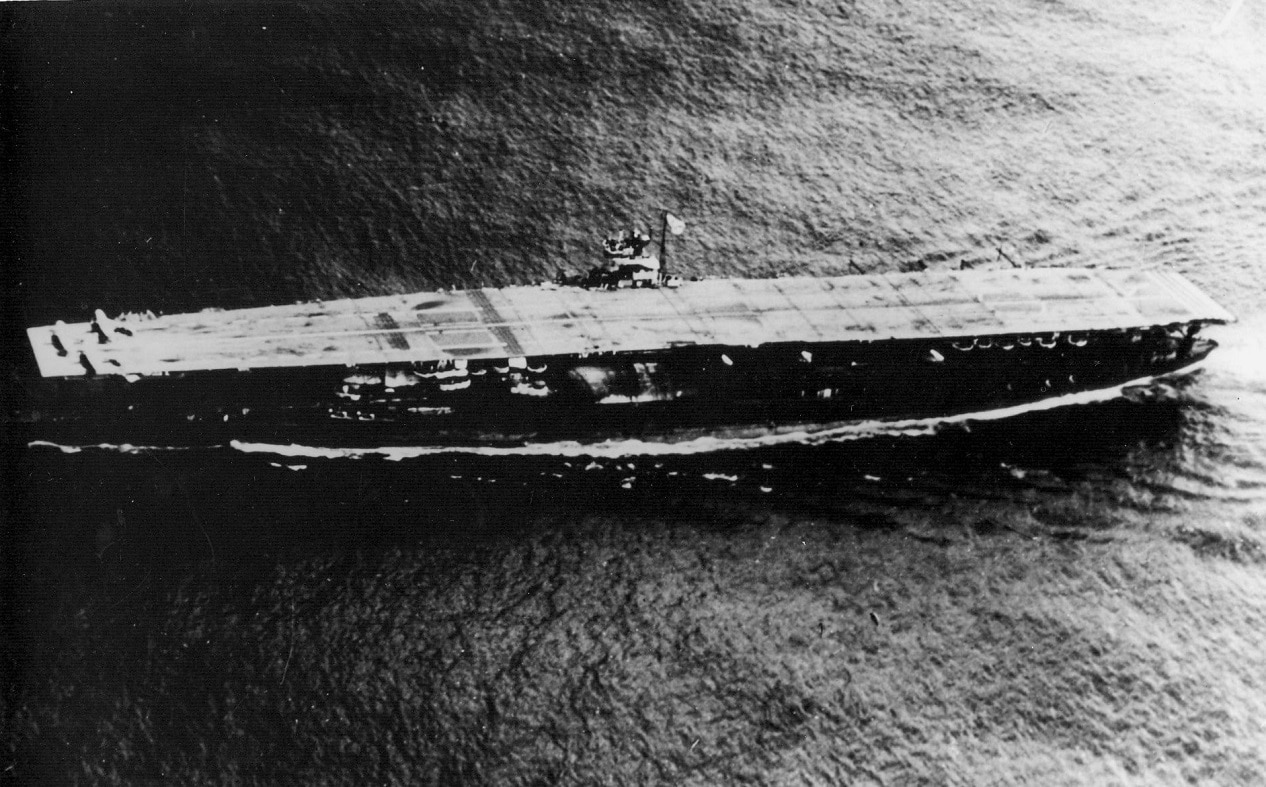
In the final months of World War II, Japan secretly built one of the largest warships ever constructed. Originally designed as a super battleship, the vessel was transformed into an enormous aircraft carrier after the disaster at Midway and rushed into service as Japan’s military situation deteriorated. Almost nobody outside Japan knew exactly what had been built inside the heavily guarded shipyard at Yokosuka. Then, on November 28, 1944, the new carrier left port for the first time. Before it could reach its destination or launch a single aircraft in combat, an American submarine found it. Six torpedoes were fired. Four hit. Seventeen hours into its maiden voyage, the Shinano was at the bottom of the Pacific.
Japan’s Secret Super-Carrier Was Built For A War It Was Already Losing
The Shinano had not originally been intended to become an aircraft carrier at all. She was laid down as the third member of the Yamato class, alongside the enormous battleships Yamato and Musashi, which had been designed to embody Japan’s belief that massive surface warships could still determine the outcome of a modern naval war. But the Battle of Midway in June 1942 changed that calculation dramatically. Japan lost four fleet carriers, and the naval high command decided that the unfinished Shinano would be converted into an aircraft carrier instead.
The result was an extraordinary hybrid. Rather than functioning like a conventional fleet carrier packed with aircraft, Shinano was intended partly as a mobile support and replacement platform. She had a heavily armored flight deck, extensive aviation facilities and enough space to transport replacement aircraft and supplies for other carriers. At full load, she displaced roughly 72,000 tons, making her the largest aircraft carrier in the world at the time. Her four steam turbines were designed to produce up to 150,000 shaft horsepower, giving her a theoretical top speed of about 27 knots.
Japan went to extraordinary lengths to keep the ship secret. Construction took place inside a heavily protected dry dock at Yokosuka, surrounded by a roofed concrete enclosure that prevented outsiders from seeing what was being built. The Kempeitai, Japan’s military police, monitored the workers, cameras were forbidden and workers were warned of severe consequences if they revealed information about the ship. American intelligence did not obtain a clear photograph of the vessel until November 1, 1944, only weeks before she entered service.
The secrecy made sense from the Japanese perspective. If the Americans had understood what was being constructed at Yokosuka, they could have targeted the shipyard before the carrier ever reached the sea. Japan hoped that Shinano could eventually appear unexpectedly in the Pacific and give its weakened navy a weapon the Allies had not anticipated. But by late 1944, the Japanese military was running out of time.
The ship was rushed toward completion, and that decision would become one of the most important parts of the story.
Discover the incredible true story of how a single American submarine, the USS Archerfish, managed to sink the massive 71,000-ton Japanese supercarrier Shinano. Witness the high-stakes tension of this historic WWII naval engagement and the tactical errors that led to its downfall. Watch now for the full, gripping account!
The Carrier Left Port Before She Was Truly Ready
The Shinano was supposed to receive more time for construction, testing and preparation. Instead, Japan’s worsening military position led naval authorities to demand an accelerated schedule. The ship was commissioned on November 19, 1944, and only nine days later Captain Toshio Abe took her out of Yokosuka for what was supposed to be a transfer voyage to Kure, where she could receive additional aircraft and equipment.
The decision was risky because Shinano was not a finished warship in the normal sense. Only eight of her twelve boilers were operational, and just six were being used during the voyage. Important systems still had problems, and standard pressure testing of the ship’s watertight compartments had been cancelled because there was not enough time. That meant the crew did not know how well the ship would actually contain water if her hull were damaged.
There were other warning signs. On October 5, during preparations to move the enormous ship from dry dock, the caisson forming the dock gate failed under water pressure. Thousands of tons of seawater rushed into the dock and violently pushed Shinano forward before throwing her backward again. The accident injured workers and sailors and caused significant damage, although nobody was killed. The incident was soon regarded by some crew members as an ominous sign.
Now the unfinished carrier was heading into waters where American submarines were actively hunting Japanese shipping. Captain Abe knew the danger. Intelligence reports had warned that American submarines had recently departed bases in the Pacific and could be operating around Japan. He therefore waited until after nightfall on November 28 before leaving Tokyo Bay, hoping darkness and the carrier’s speed would help protect her. Three destroyers—Isokaze, Yukikaze and Hamakaze—escorted her.
Aboard the American submarine USS Archerfish, Commander Joseph Enright had no idea what was about to appear on his radar.

An American Submarine Began Chasing A Ship It Did Not Recognize
At about 10:48 p.m. on November 28, Archerfish detected a large surface contact roughly 12 miles away. Through binoculars, the crew could see only a dark shape on the horizon. At first, Enright believed it was a tanker accompanied by an escort. But the longer he watched it, the less convinced he became. The target seemed far too large and important to be an ordinary tanker.
The Japanese crew knew something was out there, too. Shinano’s radar warning equipment detected an American submarine radar signal, but the Japanese did not know where the submarine was. Captain Abe became convinced that he might be dealing with several American submarines rather than one. He even suspected that one submarine could be deliberately acting as a decoy while others maneuvered into position to attack the carrier.
That suspicion was wrong, but it reveals how uncertain the situation was on both sides. Enright was trying to determine what he was chasing, while Abe was trying to determine how many submarines were hunting him. Neither commander had a complete picture of the battle developing in the darkness.
For more than six hours, Archerfish followed the Japanese formation. The submarine could not simply charge straight toward the carrier. Shinano was faster, and her destroyer escorts posed an enormous threat to a submarine operating on the surface. Enright therefore relied on patience and prediction. He studied the carrier’s zigzagging movements and tried to anticipate where she would turn next.
Then the Japanese ship made a critical mistake—or, more accurately, a series of ordinary navigation decisions that happened to create the perfect opportunity for the American submarine. Shinano changed course.
Her speed was already being reduced by a problem with one of her propeller-shaft bearings, bringing her down to about 18 knots. That was roughly the same speed Archerfish could maintain on the surface. The advantage that should have allowed the giant carrier to escape had disappeared.
Then, shortly before 3 a.m., Shinano turned back toward the course Enright had predicted. The American submarine was waiting.
Four Torpedoes Hit The Giant Carrier
At 2:56 a.m. on November 29, Shinano turned toward the southwest and headed almost directly into the position Enright had chosen. Eight minutes later, Archerfish submerged and prepared to attack. At approximately 3:15 a.m., Enright fired all six torpedoes from the submarine’s forward tubes.
He deliberately set the torpedoes to run shallow. The idea was not simply to punch holes as low as possible in the hull. Enright wanted the explosions to occur just below the waterline, where flooding could destabilize the enormous carrier and increase the possibility that she would capsize. It was a calculated attempt to turn the weight and size of Shinano against her.
Four of the six torpedoes struck the carrier’s starboard side.
The first hit toward the stern. The second struck around the starboard propulsion area. The third hit the No. 3 boiler room, while the fourth damaged the air compressor and damage-control areas. The impacts immediately flooded several compartments, killed men inside the affected spaces and began a chain reaction that the crew struggled to contain.
At first, however, Shinano did not appear doomed. Captain Abe ordered counterflooding in an attempt to correct the list, and the carrier continued moving. The crew began pumping and fighting the incoming water. From the outside, it was entirely possible that the giant ship might survive four torpedo hits.
But the rushed construction now became a fatal weakness.
Because many parts of the ship were unfinished, water could move through spaces that should have been better sealed. Incomplete fittings, passages and penetrations allowed progressive flooding to spread beyond the compartments directly damaged by the torpedoes. The ship’s enormous size could not compensate for the fact that she had never been given the full testing and preparation normally expected of a vessel of this magnitude.
Below the surface, Archerfish was already running deep to escape the Japanese destroyers’ depth charges. The escorts attacked, but they could not locate the submarine effectively. Their sonar equipment had been damaged during earlier combat, and the depth charges fell harmlessly away from their target. The American submarine escaped. The Japanese carrier did not.
The Biggest Warship A Submarine Had Ever Sunk Was Dying
After the attack, Shinano continued steaming for hours as her crew fought desperately to save her. But the flooding kept spreading. The ship’s list increased, her pumps struggled and eventually her propulsion system failed. By morning, she had traveled roughly 36 miles from the location where the torpedoes struck before losing the ability to continue under her own power.
Two destroyers attempted to tow the enormous carrier, but the effort was hopeless. Shinano weighed tens of thousands of tons even before taking on thousands of tons of seawater. The destroyers simply could not control the massive vessel as she continued to list.
At 10:18 a.m., Captain Abe finally ordered the crew to abandon ship. The evacuation was chaotic, and many men were trapped below decks as the carrier continued to roll. Abe himself remained aboard. About 1,435 people died when Shinano went down, while more than 1,000 crew members and civilian workers were rescued.
At roughly 10:57 a.m., less than eight hours after the torpedoes struck, the giant carrier rolled over and sank by the stern.
The most extraordinary part was how little time the ship had actually spent at sea.
Shinano had left Yokosuka on November 28. By the morning of November 29, she was gone. She had not reached Kure. She had not received her intended aircraft. She had not fought a fleet engagement. She had not launched a combat mission.
She had been sunk on her maiden voyage.
The American crew initially did not even know exactly what they had destroyed. Archerfish‘s report claimed a large carrier, but U.S. intelligence officers were initially skeptical because American intelligence had not known that such a ship existed in Japanese service. Enright had made sketches of the strange vessel he had seen through his periscope, and those drawings helped investigators identify the target. After the war, Japanese records and interrogations confirmed the astonishing truth: the submarine had sunk Shinano, the enormous carrier converted from the third Yamato-class hull. For Enright and his crew, the uncertainty was finally over. They had not sunk a tanker. They had found Japan’s secret super-carrier.
The Secret Ship That Never Got To Become A Weapon
The story of Shinano is remarkable not simply because a submarine sank a huge aircraft carrier. It is remarkable because almost everything about the ship’s existence was shaped by a desperate attempt to reverse Japan’s worsening position in the Pacific.
The Japanese had taken a battleship hull intended to represent overwhelming naval power and transformed it into an enormous aircraft carrier after losing four carriers at Midway. They then hid the ship from American intelligence, rushed its construction as the war approached Japan’s home islands and sent it into dangerous waters before all of its systems had been properly tested.
The Americans, meanwhile, did not know they were hunting Shinano. Commander Enright initially thought he was following a tanker. He spent hours chasing the unknown target, using radar, visual observation and careful prediction to maneuver ahead of it. When the carrier finally turned into his path, he had only minutes to make the decision that would define his patrol. Six torpedoes were fired.
Four found their target. And one of the most heavily protected ships of World War II disappeared beneath the Pacific before the world had even fully learned that she existed.
USS Archerfish later received a Presidential Unit Citation, while Enright was awarded the Navy Cross for the sinking. The submarine continued serving after the war before eventually being used as a target during a torpedo test in 1968. Shinano, meanwhile, remained on the seabed as one of the most extraordinary examples of how secrecy, haste and technological ambition collided during the final years of the Pacific War.
The carrier had been designed to survive attacks that would destroy ordinary ships. It never got the chance to prove whether it could.
Japan spent years secretly transforming the unfinished Shinano into the largest aircraft carrier in the world at the time. Then, as the war turned against Japan, the enormous vessel was rushed into service before she was fully prepared. On her maiden voyage in November 1944, USS Archerfish tracked her for more than six hours before firing six torpedoes. Four struck the carrier, and progressive flooding overwhelmed the ship’s unfinished defenses. Seventeen hours after leaving port, Shinano was gone. Japan had built a secret super-carrier. It never got to fight a battle.
This story draws primarily on Kelly Bell’s historical account for Warfare History Network, republished by RealClearHistory, which reconstructs the final voyage of the Japanese carrier Shinano and the pursuit by USS Archerfish. Additional details from the U.S. Naval History and Heritage Command help verify the carrier’s construction, the four torpedo hits, the flooding, the loss of the ship and the fate of its crew. Together, these sources reveal how one of the most ambitious warships of World War II was destroyed before it could complete its first voyage. Source: https://www.realclearhistory.com/2026/04/01/the_shinano_carrier_how_allied_forces_sunk_a_secret_1173809.html