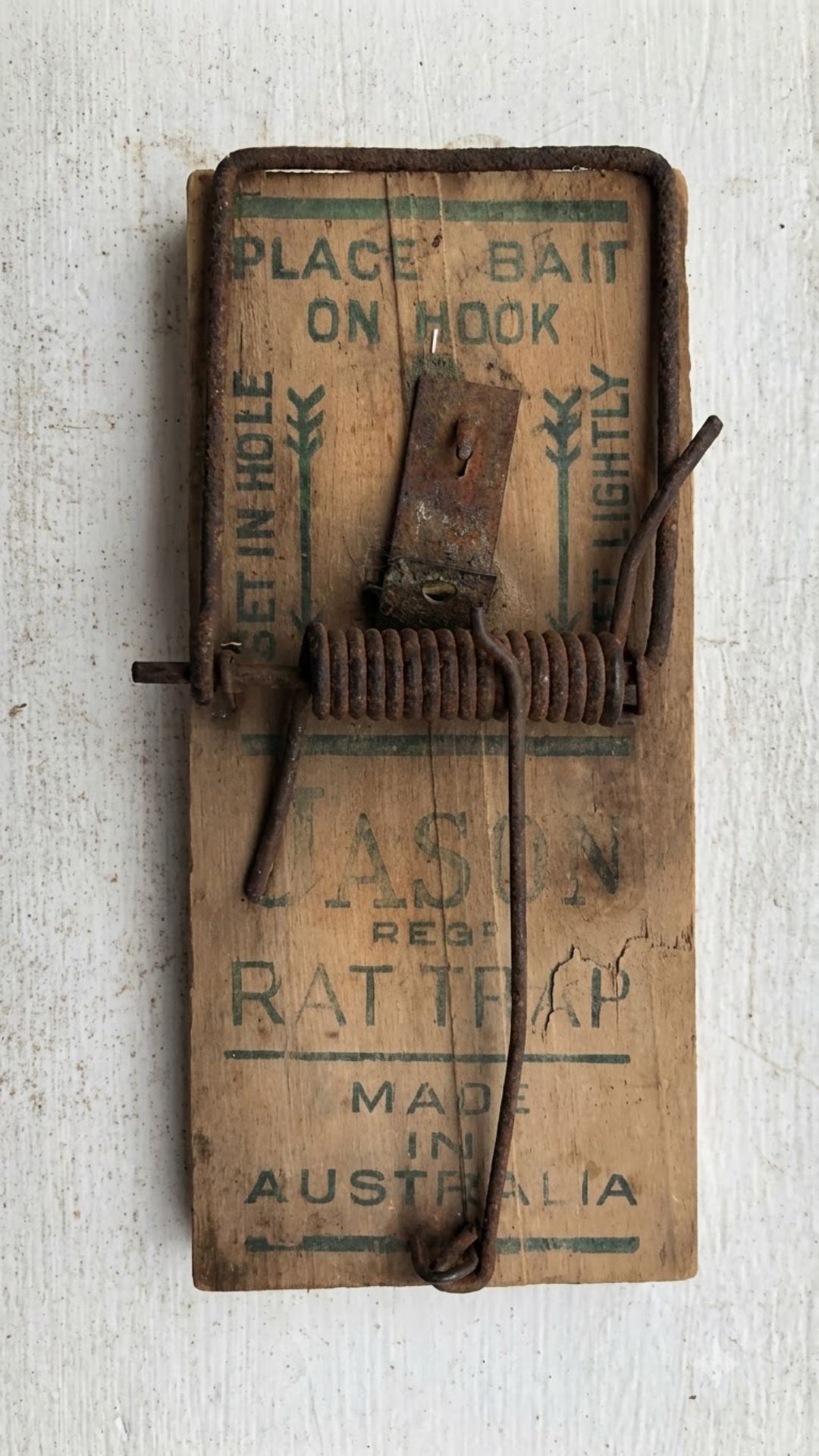
More than 4,400 mousetrap patents have been granted in the United States since the Patent Office was established in 1838. That is more than for any other invention, according to the Smithsonian. Yet one of the most successful designs is remarkably simple: a small piece of wood, a metal spring and a bar that snaps shut when a mouse takes the bait. First patented by William C. Hooker in 1894 and later modified by John Mast, the basic snap trap became so effective that it is still produced by the tens of millions. More than a century later, inventors are still trying to improve it.
The Quest For A Better Mousetrap Started Long Before Modern Technology
The familiar phrase about building a “better mousetrap” is often attributed to Ralph Waldo Emerson, although the exact quotation is probably not his. By the late 19th century, however, the idea had become deeply connected with American invention: if a person could make an ordinary object work better, perhaps customers would come looking for it.
The mousetrap was an unusually good test of that idea. Mice were common around homes, farms, warehouses and businesses, and people needed a cheap way to catch them. The basic problem was simple, but solving it reliably required a surprisingly precise combination of bait, timing, sensitivity and mechanical force.
Long before the modern snap trap became dominant, inventors were producing elaborate devices made from wood, metal, wire, jars and other everyday materials. The Smithsonian’s collection includes mousetraps dating back centuries, including homemade designs that relied on surprisingly clever mechanisms. Some attempted to kill the mouse quickly; others were designed to capture it alive.
The Patent Office eventually became a record of this obsession. More than 4,400 mousetrap patents have been granted in the United States—an extraordinary number for a device whose basic purpose has barely changed.
Ready to win your next physics competition? Join world record holder Al and Mark Rober as they break down the secrets behind the ultimate mousetrap car. From mechanical advantage to reducing friction, learn how to engineer a vehicle that dominates on race day. Watch now and start building today!
Then A Simple Wooden Trap Changed Everything
One of the most important steps came in 1894, when William C. Hooker patented an animal trap designed to catch mice and rats. His invention used a sensitive mechanism that could be triggered when an animal attempted to reach the bait. The design was simple, inexpensive and capable of being set close to a rat hole or other location where rodents traveled.
A few years later, John Mast developed and patented an improved version of the familiar snap trap. The Smithsonian identifies Mast’s 1903 patent as the design that became the best-selling mousetrap of all time. It was not complicated technology. Its strength was that it did not need to be complicated.
The trap used a spring-loaded bar held under tension. A mouse approaching the bait would disturb the trigger, releasing the bar and allowing the spring to drive it downward almost instantly. The mechanism was cheap to manufacture, easy to reset and small enough to be used almost anywhere.
That combination turned a humble household tool into something remarkably durable. The Smithsonian describes the basic snap trap as a kind of “living fossil” of industry because its design has changed so little while remaining commercially successful.

Inventors Kept Trying To Beat A Design That Already Worked
The strange thing about the mousetrap story is that success did not end the invention process. It almost seemed to encourage it.
Inventors continued experimenting with different ways to solve the same problem. Some traps were designed to kill more quickly. Others attempted to avoid killing the animal altogether. Some used elaborate mechanisms to make the trap more sensitive, while others tried to prevent mice from stealing the bait without triggering the device.
The Smithsonian’s collection includes an 1877 trap called “The Delusion,” a multi-mechanism trap made by the Animal Trap Company of Lititz, Pennsylvania, and even a trap constructed from a canning jar with a one-way entrance. These designs reveal just how many different approaches inventors considered when trying to improve something as basic as catching a mouse.
And the experimentation did not stop with the arrival of the snap trap. The Smithsonian notes that the Patent Office has continued receiving mousetrap applications, showing that inventors remain willing to spend time and money trying to improve a mechanism that already performs its basic job extremely well.
That may be the most interesting part of the entire story. Once a product becomes “good enough,” improving it becomes much harder than inventing something from scratch. Every new design has to offer a meaningful advantage without becoming more expensive, complicated or difficult to use.
Even The Mouse Has Adapted To The Competition
The contest between people and mice has also changed in another way: mice themselves are not completely passive participants.
In the 20th century, chemical poisons seemed to offer a way around the mousetrap altogether. When warfarin was synthesized in 1948, it became an important rodent poison and appeared capable of making mechanical traps less necessary. But resistance to warfarin began appearing in mouse populations within decades, limiting the effectiveness of the chemical approach.
That created a strangely familiar pattern. Humans developed a new method for controlling mice, mice adapted, and humans continued looking for another solution.
The mousetrap therefore represents more than a piece of household hardware. It is part of a much longer technological competition in which small changes can matter enormously. A fraction of a second in a trigger mechanism, a different type of bait, or a better way to keep a captured mouse from escaping can determine whether an invention succeeds or disappears.
Why The Old Design Still Wins
The most successful mousetrap does not win because it is technologically impressive. It wins because it solves a very specific problem with very few parts.
The classic design is inexpensive, compact and reusable. It requires no electricity, complicated instructions or specialized equipment. Its mechanism can sit unnoticed until a mouse activates it, and the same basic principle has remained useful for more than a century.
That is why the story of the mousetrap is really a story about engineering. The goal of invention is not always to make something more sophisticated. Sometimes the hardest achievement is discovering the simplest mechanism that does the job reliably—and then resisting the temptation to make it more complicated.
The numbers make that lesson especially striking. Thousands of inventors have tried to create a better mousetrap, yet the basic snap trap remains one of the most recognizable examples of a design that simply works.
The Better Mousetrap May Already Have Been Built
More than a century of experimentation has produced thousands of mousetrap patents, but history has been surprisingly unforgiving toward most of them. The majority became curiosities, museum objects or forgotten patent records, while the simple spring-loaded trap survived.
The Smithsonian’s National Museum of American History holds numerous examples that document this long search, from homemade wooden devices to elaborate mechanical traps. Together, they show how a tiny household problem became an unlikely showcase for American ingenuity.
Perhaps that is why the mousetrap remains such a useful symbol of invention. It demonstrates that progress does not always come from adding more technology. Sometimes, after thousands of attempts to improve an idea, the winning invention is the one that does almost exactly what its predecessor did—only simply enough, cheaply enough and reliably enough to survive.
The history of the mousetrap is a reminder that invention is not always about creating something dramatically new. More than 4,400 patents show how many people have tried to improve one remarkably small problem, yet the basic snap trap developed from designs patented in the 1890s remains familiar today. Its success comes from an engineering principle that applies far beyond pest control: when a simple design solves a problem exceptionally well, replacing it can be much harder than improving it.
If you want to see how this unlikely invention became part of American technological history, the Smithsonian’s original article provides the deeper story and images of the traps preserved in its collections. Source: https://www.smithsonianmag.com/smithsonian-institution/unceasing-american-quest-build-better-mousetrap-180957208/