On June 15, 1859, an American settler on San Juan Island picked up his gun and shot a pig. The animal had repeatedly wandered into his garden and destroyed his potatoes, and its owner was a British employee of the Hudson’s Bay Company. What followed was almost absurd: threats of arrest, American soldiers landing on the island, British warships arriving offshore and hundreds of troops facing one another with weapons ready. For more than a decade, the United States and Great Britain remained locked in a territorial dispute over the island. The only casualty of the entire confrontation was the pig.
The Pig Was Only The Beginning
The incident that became known as the Pig War began with a simple problem that had nothing to do with international politics. Lyman Cutlar, an American settler living on San Juan Island, was trying to protect his garden from a pig that kept wandering onto his property and eating his potatoes. The animal belonged to Charles Griffin, an employee of the Hudson’s Bay Company, a powerful British trading company that operated a large sheep farm on the island.
Cutlar had apparently complained about the pig before, but the problem continued. On June 15, 1859, he found the animal rooting through his garden again. This time, he shot it. What might normally have been a dispute between two neighbors quickly became something much larger because San Juan Island was not clearly under American or British control.
The real problem had been created years earlier. The 1846 Treaty of Oregon had established the boundary between British North America and the United States along the 49th parallel, but the wording became ambiguous when the border reached the region around Vancouver Island. The treaty referred to the boundary following a channel to the Pacific, but there were two possible channels through the islands: Haro Strait and Rosario Strait. San Juan Island happened to sit between them.
Both countries therefore had a claim. The Hudson’s Bay Company considered the island part of British territory, while American settlers had begun arriving and establishing their own claims. By 1859, the island was effectively a small piece of disputed territory sitting between two expanding nations.
Ever wonder how a single pig sparked an international standoff? Dive into the bizarre true story of the Pig War! Discover the high-stakes border tensions and hilarious blunders between the United States and Britain. Click the link to watch this wild historical tale unfold—you don’t want to miss it!
The Pig Kept Eating The Potatoes
After Cutlar killed the pig, he reportedly offered Griffin $10 for the animal. Griffin wanted $100. The disagreement might still have ended there, but the British side threatened to have Cutlar arrested for killing company property and potentially evict American settlers from the island.
For Cutlar and the other American settlers, that was a serious threat. They believed they were living on American territory and feared that British authorities were attempting to enforce control over them. The pig had become a symbol of a much larger dispute over who actually had the right to govern the island.

The American military soon became involved. Brigadier General William S. Harney, commander of the U.S. Army’s Department of Oregon, ordered troops to protect the American settlers. On July 27, Captain George E. Pickett landed on San Juan Island with 64 American soldiers.
Pickett was not simply there to investigate a dead pig. His orders were connected to the larger question of American authority on the island. He established an American position and began preparing defenses, making it clear that the United States was willing to back its territorial claims with military force. That decision transformed a local argument into an international crisis.

America Sent Soldiers. Britain Sent Warships.
The British response was immediate and potentially dangerous. James Douglas, the governor of Vancouver Island, ordered Captain Geoffrey Phipps Hornby to confront the American presence. British warships moved toward San Juan Island, including HMS Tribune, HMS Satellite and HMS Plumper.
The situation now looked remarkably close to war. American soldiers were establishing defensive positions on land while British naval forces gathered offshore. Reinforcements continued to arrive, and the possibility of an armed confrontation became very real.
Yet there was an important difference between this crisis and many other military confrontations of the nineteenth century: neither side actually wanted to start a war over the island.
Rear Admiral Robert Baynes, the senior British naval commander in the Pacific, reportedly refused to obey an order that could have forced his ships into an armed confrontation with the Americans. He considered the prospect of going to war with the United States over a dispute that had begun with the shooting of a pig to be unacceptable.
That restraint mattered enormously. Had either side opened fire, the incident could have escalated far beyond San Juan Island. The United States and Britain were powerful nations with interests across North America and the Pacific, and a local confrontation could easily have produced consequences that neither government intended.

The Soldiers Faced Each Other—But Did Not Fire
More American troops arrived, and the British strengthened their position as well. At the height of the crisis, more than 500 American soldiers and British Royal Marines were present on the island, supported by British warships.
But despite the weapons, military camps and tense political situation, something surprisingly peaceful began to develop.
The soldiers did not spend their days trying to provoke one another. Instead, the two military communities gradually developed a strange relationship. They interacted socially, organized activities and even celebrated holidays together. The Americans celebrated Independence Day, while the British marked Queen Victoria’s birthday.

There were also horse races and other forms of entertainment. The two forces remained military opponents on paper, but the men on the ground had little personal reason to hate one another.
That unusual atmosphere helped prevent the situation from becoming violent. Both sides understood that the men standing across from them were not necessarily enemies. They were soldiers following orders while their governments argued over a piece of land.
Meanwhile, diplomats searched for a solution.
In October 1859, General Winfield Scott arrived and negotiated an agreement for a temporary joint occupation. Each country would maintain a limited military presence while the larger territorial question was left unresolved. The arrangement was supposed to be temporary. Instead, it lasted for years.

The Pig Was Dead. The Border Was Still A Mystery.
With the immediate crisis under control, the United States and Britain effectively divided administrative responsibility on the island without actually deciding who owned it. The Americans established what became known as American Camp, while the British established English Camp.
The two forces remained on San Juan Island for nearly 12 years.
Think about how strange that situation was. A pig had been shot in a garden in 1859, but the soldiers sent in response remained on the island long after the animal, the original argument and even many of the people involved had disappeared from the scene.
The underlying problem was never really the pig. The pig simply exposed the weakness of the treaty that had supposedly settled the border.
As the years passed, the United States and Britain avoided turning the dispute into a larger conflict. The American Civil War also shifted political attention elsewhere during the 1860s, and the San Juan question remained unresolved.
Eventually, however, both governments agreed that the border had to be settled permanently. And the decision would be made by someone who was not American or British.

The Decision Finally Went To A Kaiser
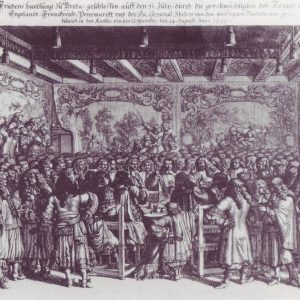
In 1871, the Treaty of Washington established a process for resolving several disputes between the United States and Britain. The San Juan Island boundary question was sent to international arbitration.
The arbitrator was Kaiser Wilhelm I of Germany.
The choice was significant because it meant that the two countries had agreed to accept the decision of a neutral outside authority rather than risk resolving the dispute through military force.
After considering the competing claims, Wilhelm ruled in October 1872 that the boundary should pass through Haro Strait. That decision placed the San Juan Islands on the American side.
The British withdrew from the island in November 1872. The final American troops left in July 1874.
After more than a decade, the strange military standoff was finally over.
The United States had won the territorial dispute, but it had done so without firing a single shot at Britain.
A War With No Battle
The name “Pig War” was reportedly coined as a humorous description of the episode years later. At the time, the people involved would have understood that the situation was anything but funny.
There had been real soldiers, real warships and a genuine possibility of violence. The United States and Britain had already fought each other in the War of 1812, so the prospect of another armed confrontation between the two countries was not unimaginable.
Yet San Juan Island became a rare example of how a military crisis can be defused without anyone surrendering or firing a shot.
The soldiers were prepared to fight if ordered. Their commanders understood the stakes. But individuals on both sides repeatedly chose restraint, while diplomats eventually found a peaceful mechanism for settling the underlying dispute.
The entire episode also reveals something important about international borders. Maps can make borders look precise and permanent, but behind those lines are treaties written by people, geographical features that can be interpreted differently and communities whose lives may not fit neatly into political boundaries.
On San Juan Island, a single ambiguous phrase in a treaty helped create a crisis that lasted for 12 years. The pig merely provided the spark.

The Pig War Was Really A Story About Avoiding War
In the end, the most remarkable part of the Pig War is not that a pig was killed. It is that the shooting of one animal nearly became the trigger for a confrontation between two major powers, yet neither side allowed the situation to spiral into bloodshed.
Lyman Cutlar wanted his potatoes protected. The Hudson’s Bay Company wanted compensation for its property. American settlers wanted protection from British authorities. Britain wanted to defend its claim to the island. The United States wanted to defend its own territorial position.
Every side had something at stake.
But instead of turning those competing interests into a battlefield, the two countries maintained an uneasy peace until a neutral arbitrator could finally decide the question.
In October 1872, Kaiser Wilhelm I awarded the San Juan Islands to the United States. The British left, the Americans eventually followed, and the long dispute disappeared into history. The pig, however, remained the only casualty.
In 1859, Lyman Cutlar shot a pig that had repeatedly destroyed his potatoes. Within weeks, American soldiers had landed on San Juan Island and British warships had arrived offshore. Hundreds of troops faced one another over a territorial dispute created years earlier by an ambiguous treaty. Yet neither side fired a shot. Instead, Americans and British lived alongside one another for 12 years before Kaiser Wilhelm I of Germany ruled in favor of the United States in 1872. The pig died, the border was settled, and two nations walked away from a war that never happened.
This article is based primarily on historical records and material from the U.S. National Park Service concerning the San Juan boundary dispute and the Pig War. Source: https://www.thecollector.com/pig-war-1859/