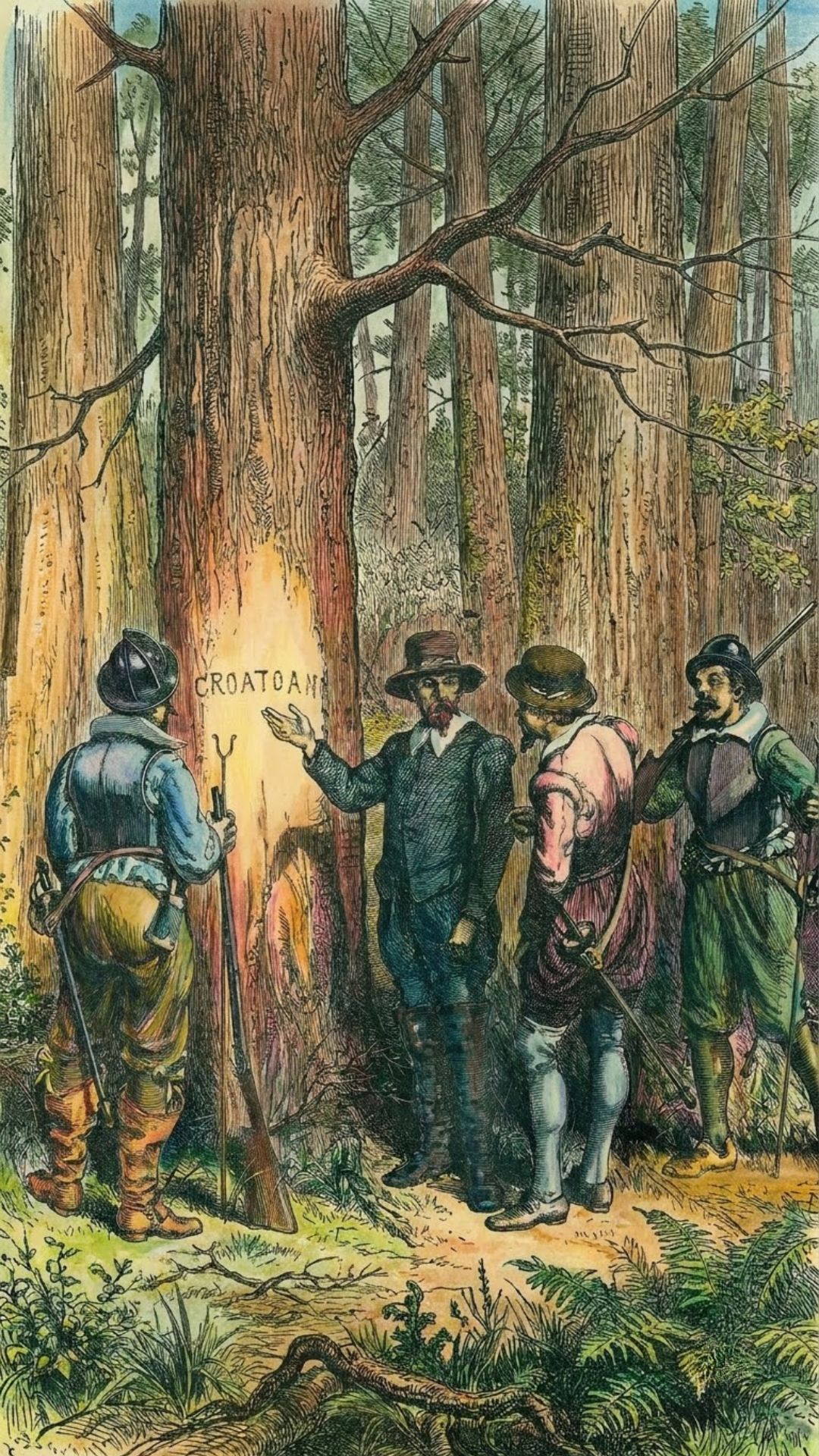
In 1590, John White returned to Roanoke Island expecting to find more than 100 English settlers he had left behind three years earlier. Instead, the settlement was empty. There were no bodies, no obvious signs of a massacre and no explanation—only a single word carved into wood: CROATOAN. For centuries, the disappearance became one of America’s greatest historical mysteries. But new archaeological evidence is reviving an older possibility: perhaps the colonists did not vanish at all. Perhaps they simply went somewhere history failed to follow.
The Colony That Vanished
The story began in 1587, when John White led a group of 117 men, women and children to Roanoke Island, off the coast of present-day North Carolina. The English hoped to establish a permanent settlement in the New World, and among the colonists was White’s daughter, Eleanor Dare, who soon gave birth to Virginia Dare—the first English child born in the Americas.
But the colony was struggling almost from the beginning. Food was limited, relations with nearby Algonquian communities were uncertain, and the settlers needed additional supplies. White eventually agreed to sail back to England to obtain them, expecting to return quickly.
Instead, war with Spain and other delays kept him away for three years.
By the time White finally reached Roanoke again in August 1590, the settlement had been abandoned. The buildings had not simply been destroyed in a violent attack; according to the National Park Service, they appeared to have been dismantled. There were no obvious signs of a desperate struggle or a hurried evacuation. Then White discovered the clue that would define the mystery for centuries.
The word CROATOAN had been carved into a palisade. It was not a random word. Croatoan was the name of both a nearby island—today’s Hatteras Island—and the Indigenous people who lived there. White already knew the Croatoan people, and a Croatoan man named Manteo had lived and worked with the English colonists.
To White, the message seemed to point toward a destination. But before he could properly investigate, a storm forced him to abandon the search and return to England. He never found out what had happened to the settlers.
Ever heard of America’s oldest mystery? In 1587, 115 colonists vanished from Roanoke Island without a trace, leaving only a cryptic carving behind. Was it conflict, assimilation, or something supernatural? Dive into the theories behind this chilling historical disappearance in our latest video. Watch now to uncover the truth!
The Clue That May Have Been An Instruction, Not A Mystery
For generations, the word CROATOAN has been treated almost like a supernatural clue—a mysterious message left behind by people who disappeared without a trace.
But there is a simpler possibility.
What if it was simply telling John White where they had gone?
Before leaving Roanoke, White had instructed the colonists that if they moved, they should leave a message indicating their destination. If they were in danger, they were also supposed to carve a cross into a tree or other object near the message. When White returned, he found CROATOAN—but no cross.
That distinction matters.
It does not prove that the colonists moved to Hatteras Island. But it makes the possibility difficult to dismiss.
The Croatoan community already had connections with the English, and the colonists were facing serious problems on Roanoke. Moving to a place where they could potentially obtain food, protection and local knowledge would not have been an impossible decision.
The problem was that White never got the chance to find out.
Over the next four centuries, historians and archaeologists would propose almost every imaginable explanation. Some suggested disease or starvation. Others suspected attacks by Indigenous groups or the Spanish. Another theory placed the colonists farther north near the Chesapeake Bay. Still another suggested they moved inland along the Albemarle Sound. But the Hatteras theory never disappeared. And now, archaeology is giving it new life.

Evidence Buried On Hatteras Island
Recent archaeological work has produced clues that fit surprisingly well with the idea that some of the Roanoke colonists moved south and lived among the Croatoan.
Among the discoveries are tiny fragments of worked metal known as hammerscale. These flakes are produced when iron is heated and hammered during metalworking. Their significance comes from the fact that the Indigenous population did not traditionally produce iron in this way, while European colonists did.
That does not mean that every piece of European metal found on Hatteras must have belonged to the Lost Colony. Europeans visited and traded throughout the region, so objects could have moved between communities without the colonists themselves moving with them.
But the possibility becomes more intriguing when the discoveries are considered alongside everything else.
There were already English artifacts found on Hatteras Island. There was the message CROATOAN. There was a known relationship between the Croatoan people and the English. And there was the practical reality that the Roanoke settlers had every reason to search for a more sustainable place to live.
Archaeologist Mark Horton and Scott Dawson of the Croatoan Archaeological Society argue that the evidence points toward the colonists relocating to Hatteras and eventually being absorbed into the Indigenous community. PEOPLE described the newly proposed interpretation as a challenge to the traditional idea that the colonists simply vanished.
If that interpretation is correct, the word “lost” may be misleading. The colonists may not have disappeared. They may have changed communities.
What If The Lost Colony Was Never Lost?
This possibility changes the story completely.
Imagine that the settlers left Roanoke not because they were attacked or mysteriously abducted, but because staying there had become too difficult. They gathered what they could carry, traveled through the waterways and coastline, and eventually reached Croatoan.
There, they would have encountered people who already knew the English and had reasons to interact with them. Some colonists may have married into Indigenous families. Others may have learned local customs and languages. Over time, their English identity could have become less visible as they became part of a larger community.
Their descendants could have remained in the region even as the original colony disappeared from European records.
From the perspective of an English official returning three years later, however, the result would have looked exactly like a disappearance.
The settlement was empty. The people were gone. And the only written clue pointed somewhere else.
That is perhaps the most fascinating possibility of all: the mystery may have been created not because nobody knew where the colonists went, but because nobody followed them far enough to find out.
The National Park Service itself recognizes relocation to Croatoan as one of the major theories surrounding the colony. Archaeological discoveries on Hatteras have produced objects dating to the period, although no human remains, graves, buildings or village site have been definitively connected to the Lost Colony. That last point is crucial. The evidence is intriguing. It is not conclusive.

The Mystery Is Not Solved Yet
There is a temptation with a mystery this old to declare victory as soon as a plausible explanation appears. But Roanoke does not give up its secrets that easily.
The archaeological evidence on Hatteras can support the idea of interaction between Europeans and Indigenous people without proving exactly who the Europeans were. The artifacts might have belonged to the Roanoke settlers—or they might have arrived through trade. Even the presence of English objects does not tell us whether all 117 colonists reached the island, whether only some did, or what happened to them afterward.
Other theories remain possible.
Some colonists may have moved inland. Some may have died from disease or hunger. Some may have joined Indigenous communities in more than one location. And some may never have survived the difficult years after White sailed away.
The National Park Service notes that no single theory has definitively explained the fate of the Lost Colony. More than four centuries after White returned to Roanoke, the evidence still does not allow historians to reconstruct the entire story with certainty.
But perhaps the most important change is not that archaeologists have finally solved the mystery.
It is that they may be changing the question. For centuries, we have asked: What happened to the Lost Colony? Perhaps the better question is: Why did we assume they were lost in the first place?
For more than four centuries, the fate of Roanoke’s settlers has been treated as one of America’s great disappearance mysteries. Yet the evidence increasingly suggests a less dramatic—and perhaps more fascinating—possibility: some of the colonists may have left Roanoke and joined the Croatoan community on Hatteras Island. The word CROATOAN, archaeological discoveries and traces of European metal all fit that story, but none proves it completely. The mystery remains unsolved. What may be changing, however, is our understanding of what “lost” really means.
This article is based on historical records and archaeological reporting from the National Park Service and PEOPLE concerning the Roanoke colony and recent interpretations of evidence found on Hatteras Island. Source: https://people.com/new-theory-suggests-mystery-of-the-lost-colony-of-roanoke-is-more-of-a-misconception-11963293