For years, OMHU watched its distinctive TEDDY™ sofa appear across the internet in cheaper versions that looked remarkably similar. The Copenhagen furniture company could have responded with lawsuits, complaints or cease-and-desist letters. Instead, it did something far stranger: it copied its own sofa. OMHU created TEDY™, deliberately removing one “D”, giving it a bright orange cover and listing it on the same low-cost marketplaces where shoppers were finding the knockoffs. The joke was clever. But behind it was a serious question about what consumers are actually paying for when a design can be copied in seconds.
The Sofa That Became Impossible To Ignore
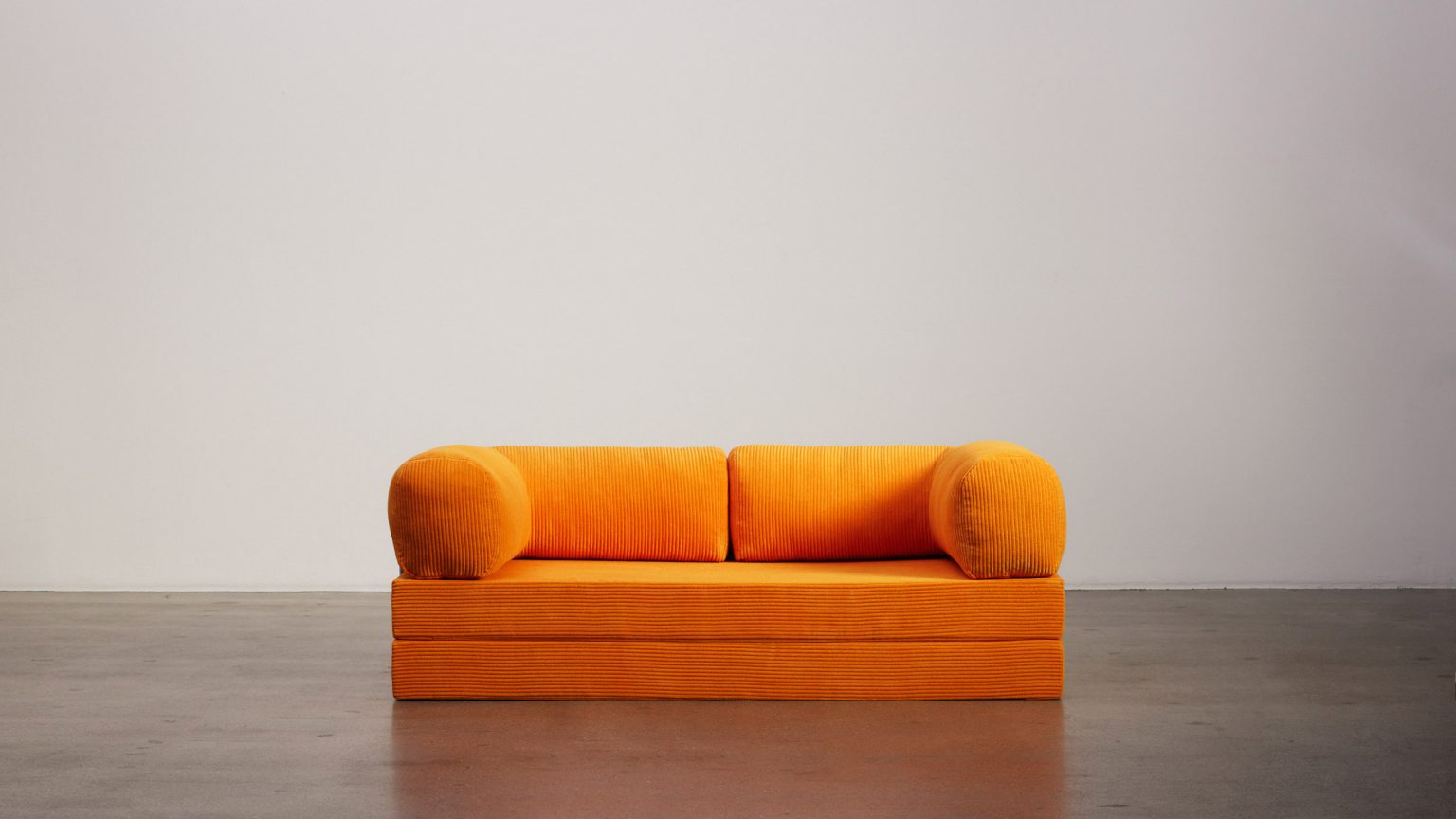
TEDDY™ was never designed to look like an ordinary sofa. Low to the ground, modular and almost completely free of the traditional sofa frame, it has a distinctive appearance that made it easy to recognize—and apparently just as easy to imitate.
OMHU was founded by Frederik Frøsig and Jonas Larsen, two longtime friends who had previously run a vintage furniture business in Copenhagen. Their experience buying and selling older furniture helped them understand what people actually wanted to live with, rather than simply what looked impressive in a showroom.
Around 2022, they began developing their own product. The idea was surprisingly simple: create a soft, mattress-like sofa that could also function as a bed. That became TEDDY™.
The design was intentionally uncomplicated. Foam sections, cushions, chrome tubes and removable covers replaced many of the conventional components found in traditional sofas. The result was comfortable-looking, highly visual and perfectly suited to the kind of interior photography that spreads quickly online. Then the copies started appearing.
Thinking about buying the viral Teddy Sofa? Before you spend your money, watch my honest review! I break down the comfort, fabric quality, and the reality of living with this unique sofa bed. Don’t make a purchase until you’ve seen the truth about its design and long-term performance. Click now!
Soon, The Internet Was Full Of TEDDY Lookalikes
Once TEDDY™ became popular, cheaper versions began showing up across online marketplaces. Some were sold under completely different names, while others were marketed specifically as alternatives to the OMHU sofa.
For shoppers, the attraction was obvious. Why spend thousands on an original when another sofa appeared to offer almost the same shape for hundreds of dollars less?
That question is at the heart of the modern “dupe” economy.
Social media has made it remarkably easy for consumers to discover a design, search for a cheaper version and compare the two products side by side. A product can become famous on Instagram or TikTok long before most consumers know anything about the company that designed it.
And once a distinctive shape becomes recognizable, reproducing its visual language can become a business opportunity of its own.
For OMHU, however, the growing number of copies presented a problem that was not solved simply by telling people that the original was better. The company decided to enter the world of dupes itself.

Then OMHU Copied Its Own Sofa
Instead of pretending the copycat market did not exist, OMHU created TEDY™.
The name was almost the joke itself. TEDY™ was TEDDY™ with one fewer “D”. It was given an intentionally bright “dupe-orange” cover and a special label designed to make the distinction obvious.
But OMHU did not stop there. The company deliberately placed TEDY™ on Temu, Etsy and Dupe.com—the same kinds of marketplaces where consumers were already looking for cheaper alternatives to the original. In other words, OMHU put its own “fake” sofa directly into the environment where the real copies were competing for attention.
Only 100 TEDY™ sofas were made for the campaign, split between North America and Europe. According to OMHU, they sold out in roughly ten minutes.
The company had effectively turned the copycat problem into advertising.
Instead of asking consumers to search for the original, OMHU brought the original’s story into the world of the dupes.

The Joke Was Really About What You Cannot See
At first glance, TEDY™ looks like a marketing stunt. And it certainly is one.
But OMHU’s argument goes deeper than the joke. The company wants consumers to understand that two sofas can look almost identical in a photograph while being very different products.
TEDDY™ is designed as a modular piece that can be changed over time. Its covers can be removed and washed, and the sofa can also be converted into a bed. OMHU emphasizes the materials, manufacturing process and intended longevity of the original rather than simply its appearance.
That distinction matters because durability is almost impossible to judge from an online photograph.
A cheaper sofa may look nearly identical when it arrives at someone’s home. The differences may only become obvious months or years later—when cushions lose their shape, fabric wears out, modules shift or replacement parts are impossible to find.
The problem for brands like OMHU is that those differences are difficult to communicate in a marketplace built around quick visual comparisons. A consumer sees two pictures. One costs $2,000. The other costs a fraction of that. The question becomes almost unavoidable: What exactly am I paying for?
The Dupe Economy Has Changed How People Shop
The rise of the dupe is bigger than one sofa.
Across fashion, furniture, beauty and home design, consumers have become increasingly comfortable searching for products that resemble expensive originals without carrying the same price tag.
The logic is simple. If the goal is a certain look rather than a particular brand, why pay more?
For some shoppers, that is entirely reasonable. A person furnishing an apartment may not care who designed the sofa. They may simply want something comfortable that looks good in photographs and fits within a limited budget.
But the rise of dupes creates a difficult problem for designers.
Traditional luxury depended heavily on scarcity, reputation and recognizable names. The internet has weakened all three. A consumer can now discover a beautiful chair, lamp or sofa on social media and find dozens of visually similar alternatives with a few searches.
The original designer may have spent years developing the product. The copycat may only need a photograph. That imbalance is exactly what makes OMHU’s campaign so clever. The company did not try to pretend the dupe culture was disappearing. It used the culture itself to make people look at the original.

The Real Battle Is Over More Than A Sofa
OMHU’s TEDY™ campaign ultimately turns a funny story about a sofa into a larger argument about design in the internet age. When an object becomes famous because of its appearance, what happens when appearance is the easiest part to copy? The answer may be that brands have to make the invisible parts of their products more valuable.
Materials. Construction. Repairability. Manufacturing standards. Replaceable components. Customer service. Longevity. Those things are much harder to photograph than a beautiful living room. That is why TEDY™ was more than a deliberately misspelled sofa. It was a way of placing the original product directly inside the world of its copies and forcing consumers to ask what separates an original from something that merely looks like one.
The campaign also shows how dramatically marketing has changed. A company once tried to protect its product by keeping imitators away. OMHU did almost the opposite.
It walked into the marketplace where the imitators were already waiting, placed its own “dupe” among them and turned the entire problem into a story people wanted to talk about. And for a furniture company, that may have been the most valuable thing it could have sold.

OMHU’s decision to copy its own TEDDY™ sofa may look like an elaborate joke, but the idea works because it exposes a much bigger change in the way people shop. Online consumers can now find cheaper versions of almost anything within minutes, making appearance easier to compare than quality. By creating TEDY™, placing it beside the knockoffs and deliberately playing along with the culture of “dupes,” OMHU turned a threat into a marketing opportunity. The sofa itself was only part of the story. The real product was the question it left consumers asking: Is looking the same enough?
The story was reported and documented through OMHU’s own campaign materials and coverage of the TEDY™ launch, including its limited-edition release on major dupe marketplaces. Source: https://www.dezeen.com/2026/09/08/omhu-tedy-teddy-dupe-sofa/