On September 9, Norway said goodbye to King Harald V in a state funeral that brought tens of thousands of people into the streets of Oslo. Harald, who died at 89 after more than three decades on the throne, had become one of the country’s most familiar national figures, known for an unusually open and inclusive style of monarchy. His coffin was carried through the capital to Oslo Cathedral, then taken to the royal crypt at Akershus Fortress. When the final ceremony ended, something remarkable happened: the mourning period stopped, the flags rose again, church bells rang across the country, and Norway publicly turned toward its new king.
A King Who Became A Symbol Of Modern Norway
Harald V became king in 1991 after the death of his father, Olav V. Over more than three decades, he gradually established an identity of his own, becoming known for his inclusive approach and for a willingness to speak about ordinary family life, difference and modern Norwegian society in a way that helped make the monarchy feel less distant. Reuters described him as a reformer who eventually emerged from the shadow of his charismatic and highly popular father.
His reign covered a period of major change in Norway, but his role was primarily one of continuity rather than political power. Norway remained a parliamentary democracy in which the monarch serves as a constitutional figurehead, yet Harald became a familiar presence at national celebrations, moments of grief and major public events. For many Norwegians, his death therefore represented the disappearance of a figure who had been part of everyday national life for most of a generation.
The public response had already been enormous before the funeral. During the 13 days of national mourning, hundreds of thousands of people left flowers, candles and Norwegian flags outside the Royal Palace, creating a vast informal memorial in the center of Oslo.
Honor the life and legacy of King Harald V of Norway as dignitaries and thousands of mourners gather in Oslo to pay their final respects. Watch the full coverage of this solemn state funeral here to witness the historic farewell to a beloved monarch.
Oslo Stood Still For The Procession
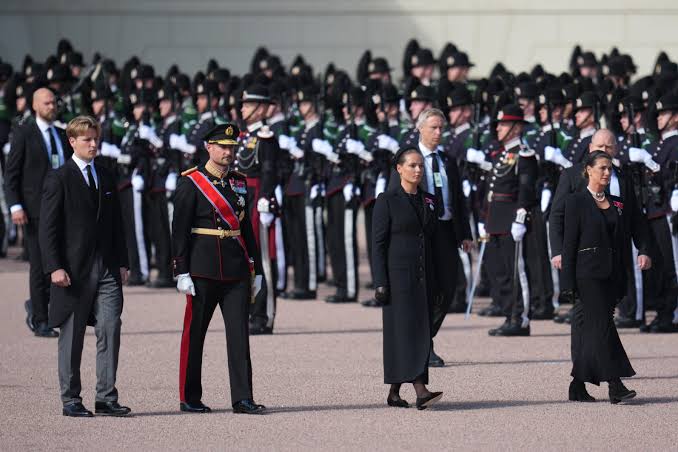
On the morning of the funeral, people lined the streets as the coffin moved slowly toward Oslo Cathedral. Some mourners wore traditional regional costumes, while others simply stood in silence as the procession passed. The scene was formal, but it also felt deeply public: ordinary citizens were not watching the ceremony from a distance but gathering to take part in the farewell themselves.
Military personnel accompanied the procession, while cannons fired from nearby Akershus Fortress. The combination of soldiers, flags, artillery and thousands of civilians gave the ceremony a distinctly historic character, even though it unfolded in a modern European capital. The funeral was both a royal ritual and a public expression of national mourning.
The scale of the crowd also answered a question that sometimes surrounds European monarchies: how much emotional importance does a ceremonial head of state still have in a modern democracy? On this day, the answer in Norway seemed unmistakable.
Royal Families And World Leaders Arrived
The ceremony also drew an extraordinary gathering of international figures. Britain’s Prince William, Japan’s Crown Prince, and the kings of Denmark, the Netherlands, Sweden and Spain attended, along with senior political leaders including the presidents of Germany and Finland, France’s prime minister and Ukraine’s President Volodymyr Zelenskiy. The United States was represented by Allison Hooker, Under Secretary of State for Political Affairs.
Their presence reflected more than royal etiquette. Norway occupies an important place in European diplomacy and security, while the country’s monarchy remains connected by family and history to other royal houses across Europe. Zelenskiy’s appearance was particularly notable because he had arrived in Oslo the previous day and had also been meeting Norwegian officials about Ukraine’s military and air-defense needs.
Still, the international guests were not the emotional center of the day. That was the Norwegian public, whose presence transformed the ceremony from a formal state event into a national farewell.

The Final Journey To Akershus Fortress
After the funeral service at Oslo Cathedral, four F-35 fighter jets flew overhead. One aircraft broke away from the formation, creating a symbolic moment that marked the king’s passing before the coffin began its final journey toward Akershus Fortress.
The smaller procession moved to the rhythm of Chopin’s Funeral March as it approached the fortress overlooking Oslo’s harbor. There, Harald was placed in the royal crypt beside his parents, returning him to the same royal setting that had shaped so much of his family history.
Yet the burial itself was not the final symbolic act. That came when Norway stopped mourning.
Then The Bells Rang Across Norway
When the new King Haakon VIII emerged from the crypt after his father’s burial, the national mourning period officially ended. Flags that had flown at half-mast since Harald’s death were raised fully again, while church bells across Norway rang for an hour. The change was visible and audible across the country: the state had moved formally from mourning one monarch to recognizing another.
Later, Haakon, Queen Mette-Marit and other members of the royal family appeared on the balcony of the Royal Palace. The crowd responded with applause and cheers, producing a striking contrast with the silence that had accompanied the coffin only hours earlier. It was a carefully choreographed transition, but it was also an unmistakably human one.
A funeral normally marks the end of a story. In this case, it also marked the beginning of another reign.

Norway Mourned One King And Welcomed Another
Harald’s death also raised the larger question of whether the Norwegian monarchy remains relevant in modern society. The first public polling after his death suggested that it does: a Norstat poll for broadcaster NRK found that 72% of respondents continued to support the monarchy.
That support helps explain why the farewell became such a major public event. Harald had no governing authority in the conventional political sense, yet he represented continuity through decades of changing governments, social shifts and international crises. His importance was less about exercising power than about being a familiar national presence while everything around him changed.
On September 9, that chapter closed in full view of the country. The crowds dispersed, the bells stopped and the flags returned to their normal position, but Norway had already begun moving forward under a new king.
King Harald V was laid to rest in Oslo on September 9 after more than three decades on Norway’s throne. Tens of thousands lined the streets, while European royals and international leaders attended the state funeral. His coffin traveled from Oslo Cathedral to the royal crypt at Akershus Fortress with military honors and an F-35 flyover. Then the mood changed: flags were raised, church bells rang for an hour, and new King Haakon VIII appeared with his family before the crowd. Norway had not simply buried a king. It had publicly closed one era and begun another.
P.S. This article is based primarily on Reuters’ September 9, 2026 coverage of King Harald V’s funeral, with additional information from Reuters’ September 8 report and the Norwegian Royal Court’s announcement of his death. Reuters reported that Harald died on August 28 at age 89 and had reigned for more than three decades. Sources: https://www.reuters.com/world/with-large-crowds-expected-norway-lay-king-harald-rest-2026-09-09/