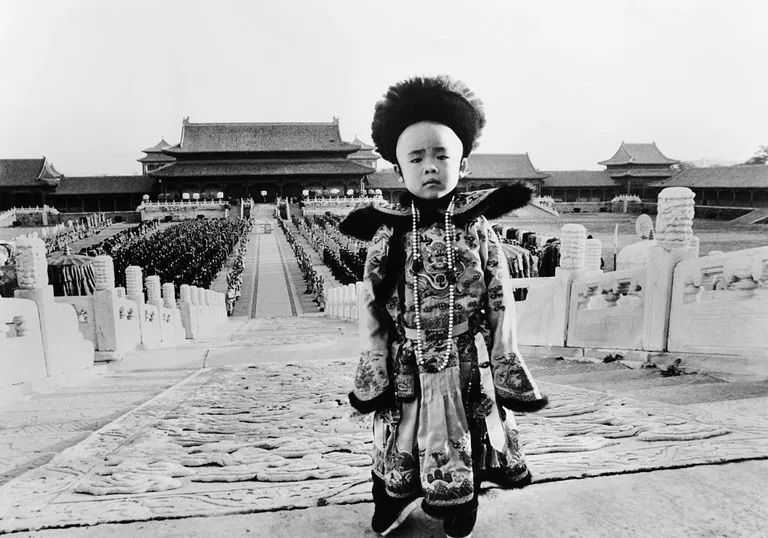
In 1908, a two-year-old boy was taken to Beijing and told that he was now the emperor of China. His name was Puyi, and he had inherited the throne of the Qing dynasty at the height of a crisis that would soon end more than two millennia of imperial rule. His position was extraordinary in another sense: the Qing realm had once contained roughly 37 percent of the world’s population around 1800, one of the largest concentrations of human beings ever ruled by a single political entity. But Puyi would not grow into the ruler of that enormous empire. Four years after becoming emperor, he was forced to abdicate at just six years old. His astonishing journey was only beginning.
A Toddler Was Placed On The Dragon Throne
Puyi was born in Beijing in 1906 into the imperial Aisin-Gioro family. When the Guangxu Emperor died in November 1908, Puyi was selected as his successor while still a toddler. He was brought into the Forbidden City, where ceremonies, court officials and imperial rituals suddenly became the setting of his childhood.
Puyi was emperor in name, but he was not independently governing a modern state. He ruled under a regency, while the Qing court attempted to manage a country facing growing political unrest, foreign pressure and demands for reform. The dynasty had ruled China since 1644, but by the beginning of the twentieth century its position had become increasingly fragile.
The scale of the empire he symbolically inherited is easy to underestimate today. At the Qing dynasty’s height around 1800, historical population estimates place the empire’s population at roughly 300 million, representing around 30–37 percent of the world’s population depending on the population series and methodology used. Cambridge’s Economic History of China describes the Qing as one of the most populous political entities in history, while demographic comparisons place it at about 37 percent of the world’s population around 1800.
But that extraordinary demographic weight did not mean the young emperor personally controlled a third of humanity. The roughly one-third figure belongs to the Qing empire at its eighteenth-century population peak, not to Puyi’s personal rule in 1908–1912. That distinction makes his story more accurate—and, in some ways, even more striking.
Ever wondered how a toddler ended up ruling 33% of the world? Dive into the fascinating and tragic life of Puyi, China’s last emperor. Watch the full story now!
The Empire Collapsed Before He Was Old Enough To Rule
In October 1911, revolution broke out against the Qing government. The uprising quickly developed into a national political crisis, with provinces breaking away from imperial control and revolutionary forces demanding the creation of a republic. Puyi was still only five years old.
On February 12, 1912, the abdication was officially announced. The final emperor of China was now a former emperor, and the Qing dynasty’s 267-year rule had come to an end. Puyi was six years old.
Yet the young boy did not immediately leave the world of emperors.
Under the terms arranged after the abdication, Puyi was allowed to retain his imperial title and continue living in the Forbidden City with the remnants of the imperial household. He remained surrounded by palace servants, rituals and traditions even though the political system that had created his position was gone.
He had lost an empire without ever having had a chance to understand what it meant to rule one.
The Boy Emperor Grew Up Inside A Palace
Puyi spent much of his childhood behind the walls of the Forbidden City. The palace remained a strange world where the old imperial order continued long after republican China had replaced it outside.
His education was designed to prepare him for an imperial role that no longer had a functioning empire behind it. He was taught traditional subjects but also learned English from a Scottish tutor, Reginald Johnston. Puyi eventually adopted the Western name Henry, a choice that reflected his growing exposure to life beyond traditional court customs.
That unusual childhood shaped the rest of his life. He had been raised to believe that he occupied an extraordinary position, yet the political reality outside the palace was changing rapidly. The result was a man who had technically been emperor twice but had spent much of his youth separated from the country he supposedly represented.
In 1924, that fragile arrangement finally ended.
Republican forces entered Beijing and gave Puyi only hours to leave the Forbidden City. The former emperor fled the palace in a fleet of automobiles, ending his extraordinary childhood inside the imperial compound.

Then He Became Emperor Again
Puyi moved to Tianjin, where he lived under increasing Japanese influence. The former ruler was still fascinated by the idea of restoring his position, and Japan soon found a use for that ambition.
In 1932, Japan established the state of Manchukuo in Manchuria, after occupying the region. Puyi was installed as its head of state, initially as chief executive and later as emperor. In 1934, he took the title Kangde and became emperor of Manchukuo.
It was the second time Puyi had worn a crown.
But the circumstances were completely different from his childhood. Manchukuo was created under Japanese control, and Puyi’s actual authority was heavily constrained. He possessed an imperial title, but the state was dominated by Japanese officials and military power.
The boy who had once lost the Chinese throne was now being presented as an emperor again. This time, however, the throne was being used by another power.
The Emperor Became A Prisoner
Puyi’s second reign ended in 1945 as Japan collapsed at the end of World War II. Soviet forces entered Manchuria, and Puyi was captured while attempting to escape. He was taken into Soviet custody and held for several years.
In 1950, he was handed over to the People’s Republic of China, which had been established the previous year. The former emperor was imprisoned and subjected to years of political reeducation.
His life had now moved through an almost unbelievable sequence.
He had been born into one of the world’s most powerful ruling families, placed on the throne as a toddler, forced to abdicate as a child, confined within a palace, expelled from that palace, installed as an emperor by a foreign power and eventually captured and imprisoned. The imperial title that had once defined his identity had become almost meaningless.
From Emperor To Ordinary Worker
In 1959, Mao Zedong granted Puyi amnesty, and he was released from prison. Instead of returning to a palace, he began living as an ordinary citizen of the People’s Republic. He worked as an editor and later as a gardener and other modest occupations; HISTORY specifically records that he worked in a mechanical repair shop in Beijing after his release.
This may have been the greatest reversal of his life.
As a child, Puyi had lived behind walls that separated him from ordinary Chinese society. He had worn imperial robes, participated in elaborate court rituals and been addressed as the Son of Heaven.
Now he was living in a completely different political and social system, earning a living rather than receiving the privileges of a dynasty.
Puyi died in Beijing in 1967 at the age of 61, as China was entering the Cultural Revolution. He had spent his life moving through worlds that had almost nothing in common with one another.
The Last Emperor Was Really A Story About A Changing China
It is easy to tell Puyi’s life as a strange personal story: a child becomes emperor, loses the throne, becomes emperor again and eventually ends up working an ordinary job.
But the larger story is about the collapse of an entire political order. When Puyi was born, China was still governed by a dynasty whose roots stretched back more than two and a half centuries. When he died, the country had passed through a republic, warlord conflicts, Japanese occupation, civil war and communist revolution. Puyi did not simply lose a throne. He lived long enough to watch the world that had created the throne disappear.
And that is what makes the February 12, 1912 abdication so remarkable. The ceremony ended the Qing dynasty, but for Puyi himself, it was only the first turning point in a life that would eventually carry him from the Forbidden City to a prison cell and, finally, to ordinary life in Beijing.
Puyi became China’s last emperor at just two years old, inheriting the throne of the Qing dynasty during its final years. At the dynasty’s eighteenth-century height, the Qing ruled a population that represented roughly a third of humanity, although that figure refers to the empire around 1800 rather than Puyi’s brief reign. Four years after taking the throne, Puyi was forced to abdicate as the Chinese empire became a republic. He later became the Japanese-installed emperor of Manchukuo, was captured by the Soviets, imprisoned by the Chinese communists and finally released in 1959. He spent his final years as an ordinary citizen. His life was not the story of an emperor who ruled a third of the world, but of a child born into immense imperial power who lived to see that entire world disappear.
P.S. The timeline of Puyi’s life is based primarily on HISTORY and Smithsonian coverage, with historical demographic comparisons used to clarify the often-repeated “one-third of the world’s population” claim. The key distinction is important: the Qing empire reached roughly one-third of global population around 1800, decades before Puyi became emperor. Sources: https://www.history.com/this-day-in-history/february-12/last-emperor-of-china-abdicates