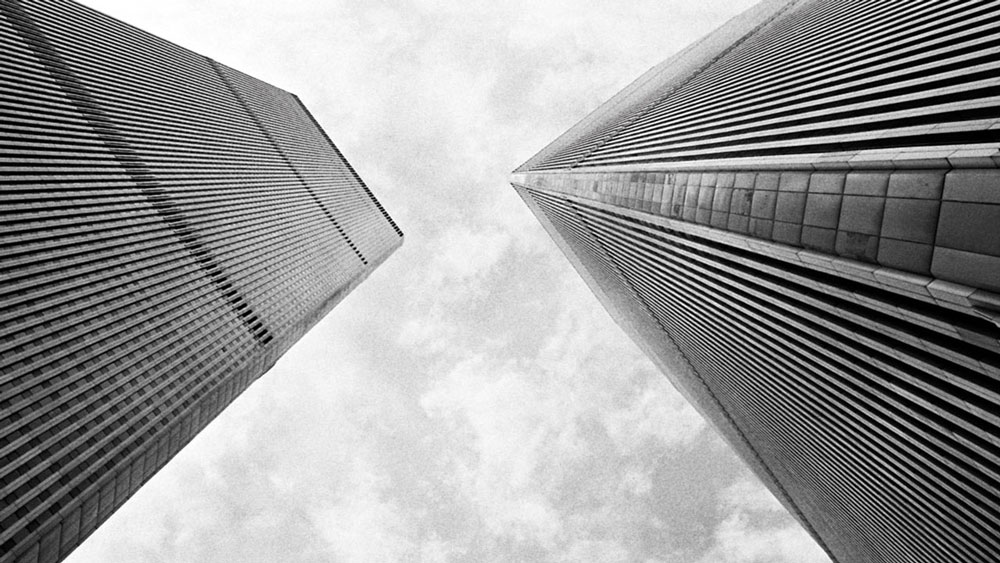
Long before the Twin Towers became synonymous with September 11, they represented something very different. They were built as the centerpiece of a vast World Trade Center complex, an ambitious project intended to strengthen New York’s role in international commerce and embody the idea that trade could promote peace. At 110 stories each, the towers transformed Lower Manhattan, attracted tens of thousands of people every day and briefly stood as the tallest buildings in the world.
The World Trade Center Began With An Idea About Peace
The idea behind the World Trade Center existed decades before the Twin Towers rose above Manhattan. In 1939, as Europe stood on the brink of another world war, business and trade associations created a temporary World Trade Center pavilion at the New York World’s Fair. Its purpose was to encourage international commerce and cooperation, with the larger belief that trade between nations could help promote peace.
That idea eventually inspired plans for a permanent World Trade Center in Lower Manhattan. The project was backed by the Port Authority of New York and New Jersey, which would build, own and operate the complex. More than a decade of planning followed before construction finally began in 1966.
What emerged was far more ambitious than a collection of office buildings. The World Trade Center was designed to become a symbol of New York’s importance in global business, with the Twin Towers as its unmistakable centerpieces.
Witness the raw, emotional accounts of the 9/11 tragedy through the eyes of those who were there. This powerful clip from “From The Love of Their Brother” captures the bravery and heartbreak of that day. Watch the full story to honor their memories and never forget. Link in bio.
They Were Designed To Be The Tallest Buildings In The World
The towers were engineered on a scale that was almost difficult to comprehend at the time. Construction began in August 1966, and the towers began their vertical climb in 1968. The North Tower was completed in December 1970, followed by the South Tower in July 1971, and the full complex was formally dedicated in 1973.
The North Tower reached 1,368 feet, or 1,730 feet including its antenna, while the South Tower stood 1,362 feet tall. At 110 stories each, they briefly held the distinction of being the tallest buildings in the world.
Their size extended far beyond height. The two towers together provided nearly 10 million square feet of office space for roughly 35,000 people and 430 companies. Each tower weighed more than 250,000 tons, contained 99 elevators and had thousands of windows.
Even the construction materials were extraordinary. More than 425,000 cubic yards of concrete were used across the World Trade Center—enough, according to the Memorial, to build a sidewalk stretching from New York City to Washington, D.C.

The Buildings Took Over New York’s Skyline
At first, the Twin Towers were not universally loved. Their enormous scale and severe modernist design drew criticism, but over time they became increasingly familiar and eventually inseparable from the image of New York itself. Their height gave Lower Manhattan a new silhouette that could be recognized from miles away.
The towers were also designed to function in ways that went beyond ordinary office buildings. Each floor occupied roughly an acre, and the buildings were equipped with a complex elevator system combining local and express service. On windy days, the towers could sway by nearly 12 inches from side to side, an unavoidable consequence of buildings designed on such an enormous scale.
The South Tower also became famous for its observation deck, which offered sweeping views across New York and beyond. On clear days, visitors could see all five boroughs, parts of New Jersey and Connecticut, and up to about 45 miles into the distance.
The World Trade Center was therefore more than a workplace. It had become a destination.
Tens Of Thousands Of People Filled The Towers Every Day
By the 1970s and 1980s, the complex had developed its own rhythm. Companies from around the world maintained offices there, while commuters, shoppers, restaurant customers and tourists moved through the site every day. The complex included seven buildings, a hotel, offices, restaurants, shops and large public areas.
The World Trade Center even had its own ZIP code: 10048.
On a typical day in 2001, roughly 30,000 to 50,000 people came to work there, while many more passed through the complex as commuters or visitors. The shopping and dining area alone occupied nearly 430,000 square feet and included more than 75 retailers.
There was also a cultural side that is easy to forget today. Artists from around the world had studios at the complex, while major sculptures and other artworks occupied public spaces. The World Trade Center was designed to project an image of international connection through both commerce and culture.
In other words, the Twin Towers were not empty monuments. They were part of a functioning city within a city.
The World Trade Center Was Attacked Before 9/11
The towers’ international reputation eventually made them targets of terrorism, but the first major attack came more than eight years before September 11.
On February 26, 1993, terrorists drove a van carrying approximately 1,200 pounds of explosives into the public parking garage beneath the World Trade Center. The bomb created a crater several stories deep in the underground levels, killed six people and injured more than 1,000.
The attack caused major damage, but it did not destroy the towers.
Instead, the complex was repaired and reopened. About 2,700 workers labored around the clock to clean, repair and restore the site. The South Tower reopened in March 1993, followed by the North Tower in April. The Port Authority also worked to restore the complex’s reputation as a place where people could work, shop and visit safely.
The bombing became an important part of the towers’ history, but at the time it did not erase their place in everyday New York life.

Why The Twin Towers Became Such Powerful Symbols
The meaning of the World Trade Center changed over time. What began as an expression of international commerce became a defining feature of the New York skyline, and its sheer scale made the towers symbols of American ambition and technological confidence.
That symbolism also carried a darker consequence. The 9/11 Memorial notes that the towers’ fame and visibility contributed to their status as targets, while the concentration of hundreds of international companies and thousands of people made the complex especially vulnerable to attack.
Yet this is also why remembering the Twin Towers only as the buildings destroyed on September 11 leaves out much of their story.
They existed for nearly three decades before that day.
During those years, they were offices, restaurants, stores, an observation deck, a workplace for tens of thousands of people and a gathering place for visitors from around the world. Their story began not with destruction, but with an ambitious belief that commerce and international cooperation could bring people together.
The Twin Towers are remembered today largely through the events of September 11, 2001, but their original story was very different. They were conceived as the heart of a World Trade Center built around international commerce, cooperation and an ideal of peace through trade. Their construction pushed skyscraper engineering to extraordinary heights and transformed Lower Manhattan for nearly 30 years. By the time they disappeared, the towers were no longer simply office buildings. They had become one of the most recognizable symbols of New York—and the world.
P.S. This article is based primarily on the National September 11 Memorial & Museum’s historical resources covering the World Trade Center’s origins, construction, daily life, cultural role and the 1993 bombing. Source: https://911memorial.org/learn/resources/digital-exhibitions/world-trade-center-history