How do you make a 31-foot yacht move faster without simply adding a bigger engine? Enata Marine’s Foiler answers that question with four carbon-fiber hydrofoils that lift the hull out of the water once the yacht reaches foiling speed. The result is a vessel designed to travel more efficiently and smoothly, while a hybrid system built around twin 320-hp BMW diesel engines and electric propulsion adds another unusual layer to the design.
It Looks Like a Normal Yacht—Until “Fly Mode”
The Foiler made its world debut at the 2018 Dubai International Boat Show and, at rest, does not immediately look like something capable of flying. Its hull sits in the water like a conventional yacht, with the unusual technology largely hidden until the captain activates it.
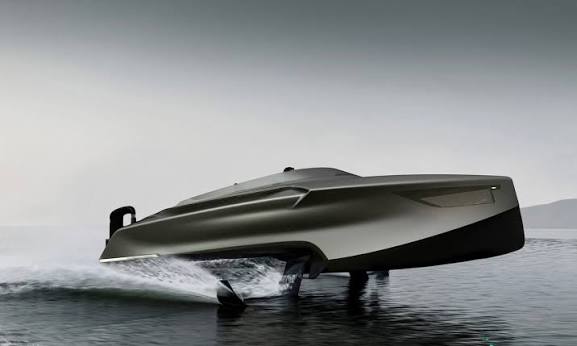
The transformation begins with a button on the dashboard. Press “Fly Mode,” and the yacht hydraulically deploys its four carbon-fiber hydrofoils; once the boat reaches about 18 knots, those underwater foils generate enough lift to raise the hull roughly 5 feet above the water. Enata says passengers can begin to feel the lift at around 12 knots.
That is the moment the Foiler stops behaving like a conventional planing boat. Instead of pushing its entire hull through the water, it relies on the submerged foil surfaces to carry much of the load while the hull rides above the waves.

The Trick Is Reducing Drag
The reason the system matters is simple physics: the less of the hull in the water, the less water the yacht has to push through. Yachting Magazine reports that the reduced drag from hydrofoiling helps give the Foiler about 20 percent better fuel efficiency at hydrofoiling speeds compared with its conventional configuration.
The benefit is not only efficiency. With the hull lifted above the water, the yacht is designed to glide over waves rather than repeatedly slamming its hull through them, producing the smoother ride that is one of the Foiler’s main selling points. Enata claims the system can effectively eliminate seasickness for passengers even in choppy conditions.
The Foiler can reportedly continue flying over waves as high as 6.5 feet, giving passengers a very different experience from a traditional fast yacht. At around 30 knots, the boat is also claimed to deliver handling that feels closer to a sports car, with little perceived lag between steering input and the yacht’s response.
It looks like a normal 31-foot yacht—until the captain presses “Fly Mode” and the hull rises 5 feet above the water. Watch the video to see the Foiler’s hydrofoil system in action and discover how it uses underwater wings to cut drag, smooth the ride and reach speeds of up to 40 knots.
Then BMW Power Enters the Picture
The Foiler does not rely on a purely electric drivetrain. Its hybrid propulsion system combines two 320-hp BMW diesel engines, two electric generators and two Enata electric torpedoes that ultimately drive the yacht.
In normal operation, the BMW engines drive the generators, while electrical power is sent to the two electric propulsion units. That arrangement allows the yacht to combine conventional diesel power with electric drive rather than forcing the entire vessel to depend on batteries.
There is also a quieter mode for situations where noise matters. The Foiler can operate solely on battery power for around 10 minutes at 10 knots, allowing it to leave or enter a harbor with almost no engine noise.

It Can Go From “Flying” Back to Floating
One of the cleverest parts of the design is that the Foiler does not have to remain on its foils all the time. When the captain wants conventional operation, pressing “Float Mode” retracts the foils and returns the yacht to a standard configuration.
That flexibility matters in places where the boat is moving slowly or coming alongside a dock. The foils are most useful once the yacht reaches the speeds required for lift, while conventional operation is more practical at rest and at low speeds.
The system was also designed with storage in mind. When the foils and propellers are raised, the Foiler can fit inside a superyacht garage; in that configuration, it measures about 10 feet 10 inches wide and 7 feet 6 inches high.
Why This Is Different From a Normal Fast Yacht
A conventional high-speed yacht generally gains speed by using more propulsion to push a hull through the water. The Foiler takes a different route: it changes the relationship between the hull and the water itself, using hydrofoils to lift the hull and reduce the drag that normally limits speed and efficiency.
That is why the most interesting part of the Foiler is not its top speed of 40 knots. It is the fact that the boat changes its physical mode of travel as it accelerates: floating normally at low speed, then lifting onto its foils once sufficient speed is reached.
The result is a yacht that tries to solve several problems at once—speed, efficiency, comfort and noise—without abandoning conventional propulsion entirely. It is less about making a boat look futuristic and more about changing how the boat interacts with the water beneath it.

The 31-foot Foiler is unusual because its biggest performance feature is hidden underwater. Four carbon-fiber hydrofoils can lift the yacht about 5 feet above the surface, reducing drag and allowing it to reach a reported 40-knot top speed while delivering a smoother ride over waves as high as 6.5 feet. Its hybrid system combines twin 320-hp BMW diesel engines with electric propulsion, and with a press of “Float Mode,” the foils retract so the yacht can return to conventional operation or even fit inside a superyacht garage.