The biggest volcano in the solar system is so enormous it would make Mount Everest look small—and it isn’t even on Earth. But that’s not the strangest part. One volcano on our planet is taller than Everest when measured from its base, while another giant went undiscovered until 2003 because most of it was hiding beneath the Pacific Ocean. The largest volcanoes are far more massive—and far more surprising—than most people realize.
Olympus Mons: The Giant on Mars
If the largest volcano in the solar system were placed on Earth, it would be almost impossible to ignore.
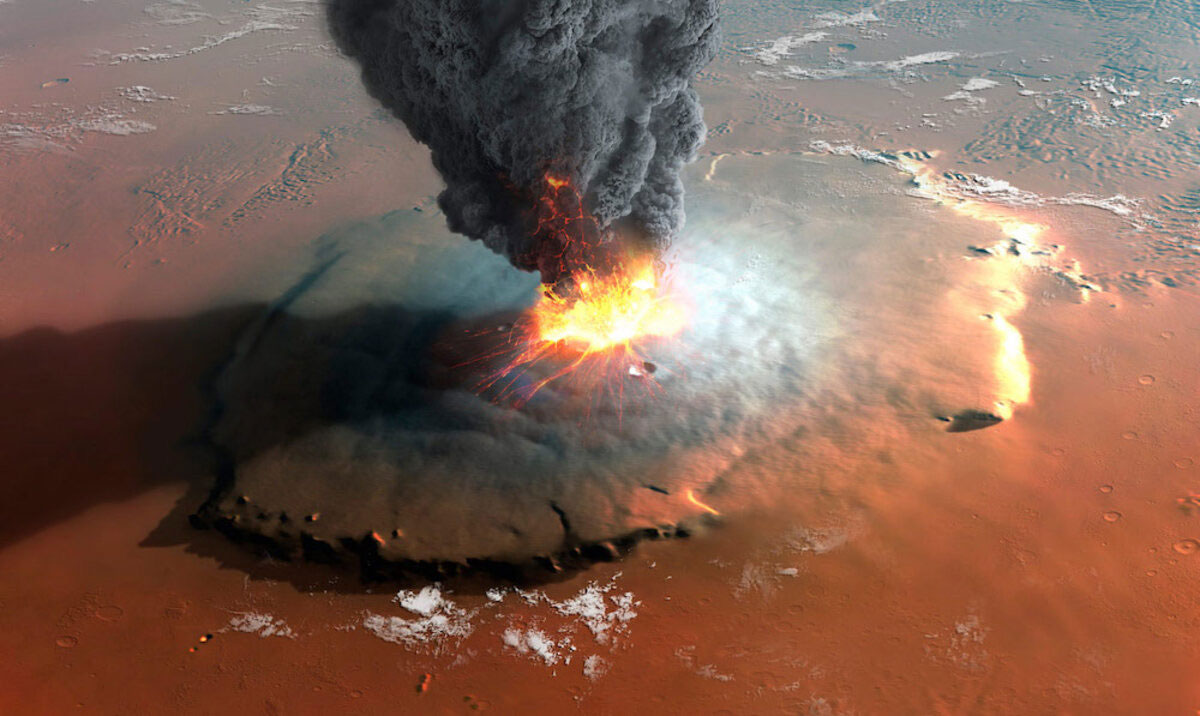
Olympus Mons rises about 27 kilometers above the Martian surface. It is the largest known volcano in the solar system and would tower over Mount Everest.
Yet its enormous size is only part of the story.
Olympus Mons is a shield volcano, built gradually through repeated lava flows over millions of years. According to the source, those flows began roughly 115 million years ago and continued until about two million years ago. Scientists now consider the volcano apparently dormant, although they do not know whether activity may still exist deep beneath its surface.
Earth has nothing quite like it.
But it does have volcanoes that become equally astonishing when measured in less obvious ways.
Want to see the difference for yourself? Watch the video below and see how small Mount Everest looks beside Olympus Mons.
Mauna Kea: The Mountain Taller Than Everest
From sea level, Mauna Kea rises nearly 4,267 meters above Hawaii’s Big Island.
That is impressive—but it hides the most important part.
Its base lies about six kilometers beneath the Pacific Ocean. Measured from that underwater base to its summit, Mauna Kea reaches roughly 10,058 meters.
That makes it taller than Mount Everest from base to summit.
The volcano was built over millions of years above a hot spot, where molten rock rose from deep within Earth and helped create the Hawaiian island chain. Mauna Kea has not erupted in more than 4,000 years and is considered dormant, though that does not mean it could never erupt again.
Today, its summit hosts a major collection of astronomical observatories.
A volcano that once helped shape an island now helps humans study the universe.

Ojos del Salado: The Highest Volcano Above Sea Level
If Mauna Kea wins the contest from base to summit, another volcano claims the greatest elevation above sea level.
Ojos del Salado rises to about 6,893 meters on the border between Argentina and Chile.
Unlike Mauna Kea, it is not considered dormant. The source reports that its last major eruption occurred in 1993 and that the volcano continues to show quiet activity.
This raises an important question: what does “largest” really mean?
The tallest summit above sea level?
The greatest height from the base?
The biggest overall mass?
Or the widest area covered?
The answer changes depending on how you measure it.
And that leads to one of the most remarkable volcanoes on Earth.
Ojos del Salado is hard to understand from a number alone. Watch the video below to see what it looks like at nearly 23,000 feet above sea level.
Tamu Massif: The Volcano Nobody Knew Was There
In 2003, scientists identified one of Earth’s largest volcanoes.
It had been hiding beneath the Pacific Ocean.
Tamu Massif lies roughly 1,000 miles from Japan. It rises about four kilometers from the seafloor—but its true scale becomes clear only when measured across its enormous base.
According to the source, it sprawls across about 191,511 square kilometers of ocean bottom.
The volcano last erupted around 144 million years ago and is considered extinct.
That is the strange reality of volcanoes beneath the ocean: something larger than entire countries can exist without becoming part of everyday human geography.
We see mountains because they rise into the sky.
But the ocean can hide giants.

Mauna Loa: The Giant Still Alive
Mauna Loa, Mauna Kea’s massive Hawaiian neighbor, is considered the largest volcano in the world by mass and volume.
It rises about 4,000 meters above sea level and was built through the same general process of repeated lava flows above a hot spot.
Unlike Mauna Kea, however, Mauna Loa is active.
The source describes a volcano that has been erupting for more than 700,000 years and warns that future eruptions remain possible. Its broad shield shape was created layer by layer as lava emerged and spread across the landscape.
For a long time, scientists believed nearby Kilauea was simply an offshoot of Mauna Loa. It is now considered a separate volcano.
Even after centuries of studying volcanoes, the details of their relationships can change.
Few volcanoes on Earth are as massive as Mauna Loa. Watch the video below to see the giant that rises from the Hawaiian Islands.
Kilimanjaro: Africa’s Volcanic Giant
Mount Kilimanjaro is one of the most recognizable mountains on Earth.
But it is also a massive volcanic system.
Located in Tanzania, Kilimanjaro rises to nearly 5,000 meters above sea level. It consists of three volcanic cones: Kibo, Mawenzi and Shira.
Kibo is dormant, while the larger volcanic complex is estimated to have begun erupting around two and a half million years ago.
Today, Kilimanjaro is known as much for mountain climbing as for volcanology.
That transformation is one of the reasons volcanoes are so fascinating.
A structure created by fire can eventually become a landmark, a national park, a scientific site—or a destination for people who want to stand at the edge of the sky.

The Largest Volcanoes Are Still Building Worlds
The story does not end with these six giants.
Volcanic activity continues to reshape Earth and other worlds throughout the solar system. Volcanoes have altered Earth’s landscape for millions of years, while volcanic processes have also transformed places such as Io, Europa and Enceladus.
And not every volcano erupts molten rock.
The source notes that ice volcanoes may operate on some distant worlds, including moons such as Europa and Enceladus.
On Earth, volcanic activity is anything but ancient history.
The eruption of Krakatoa in 1883 changed weather patterns for years afterward. Its successor, Anak Krakatau, later continued volcanic activity in Indonesia.
The mountains may look permanent. The worlds beneath them are not.
The biggest volcanoes challenge almost every instinct we have about what a volcano should look like. The largest one is on Mars. One of Earth’s tallest begins thousands of meters beneath the ocean. Another remained hidden until 2003, while Mauna Loa is still active after hundreds of thousands of years. Together, they reveal something easy to forget: beneath familiar landscapes, and even beneath the oceans, enormous geological forces are still shaping worlds we only partly understand.